
What if the real price of that sun-drenched home in Paddington is actually $30,000 higher than the number on the contract? It is a bit of a scary thought, isn't it? You have spent years saving every cent for a deposit, only to feel like the finish line keeps moving. I know exactly how that feels. It is completely normal to have a knot in your stomach when you think about the hidden costs of buying a house in brisbane, especially when you are trying to figure out Queensland specific fees on your own.
In this guide, I am going to help you uncover the real price of property by shining a light on the $30,000 plus in extra fees most buyers forget to budget for. We will look at current 2026 stamp duty rates, the latest Brisbane City Council charges, and those tricky insurance premiums for flood zones. By the time you finish reading, you will have a clear dollar figure estimate and a plan to structure your loan. You deserve to feel confident and ready for settlement without the fear of running out of cash at the last minute.
Key Takeaways
- Learn why you should budget an extra 3% to 5% on top of your purchase price to avoid running out of cash before settlement day.
- Get a clear breakdown of the hidden costs of buying a house in brisbane, including the latest 2026 stamp duty rates and mandatory government transfer fees.
- Discover why Brisbane-specific checks like flood maps and pest inspections are non-negotiable for protecting your investment in our unique climate.
- Understand how Lenders Mortgage Insurance and bank setup fees can impact your bottom line and how to structure your loan to stay in control.
- Identify the "day one" expenses, from moving trucks to changing the locks, that often get missed in a standard property budget.
Why the Sticker Price Isn’t the Real Price in Brisbane
When you are scrolling through property apps on a Saturday morning, it is easy to get a bit of tunnel vision. You see a "Purchase Price" and compare it directly to the balance in your savings account. But in reality, the price you pay the seller is just the first chapter of the story. I like to call the actual, final number the "Total Acquisition Cost." This includes every single dollar that leaves your pocket to make that home yours. In the 2026 Brisbane market, where things move fast and competition is high, knowing your real limit is the only way to bid with confidence. If you don't account for the hidden costs of buying a house in brisbane, you might find yourself in a stressful spot come settlement day.
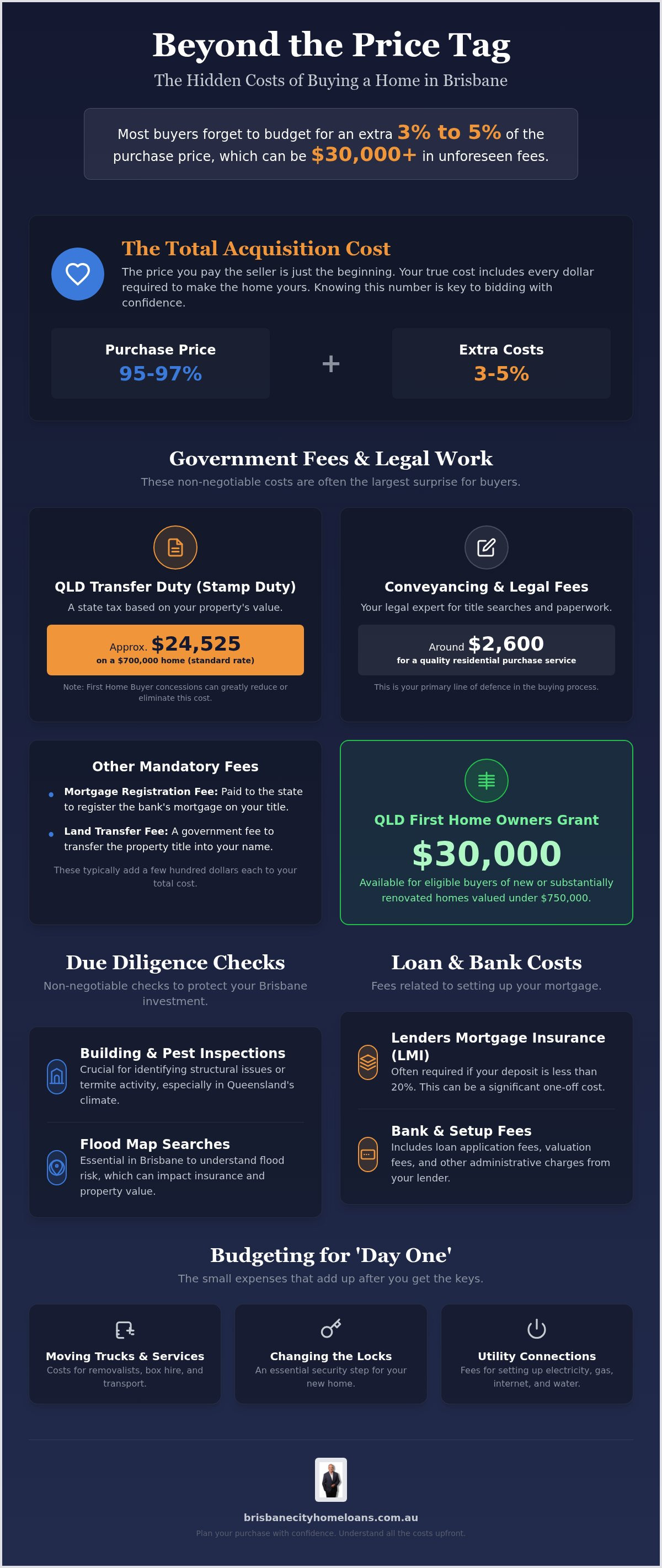
Generally, I tell my clients to budget an extra 3% to 5% of the property value for these extras. Some of these are upfront costs, like building inspections, while others are ongoing expenses that start the moment you get the keys. Getting these straight early on means you won't be caught out by a surprise bill when you should be celebrating. It is completely okay if you didn't know these costs existed; most people don't until they are already halfway through the process.
The 5% Rule: Why You Need a Buffer
Why do I suggest 5%? It might sound like a lot of money, but it is your safety net. Many buyers try to scrape by with a "bare minimum" deposit, but that is a high-risk strategy in a shifting market. If a surprise fee pops up or a bank valuation comes back slightly lower than expected, you don't want to be scrambling to find thousands of dollars in 48 hours. Having a "settlement rainy-day fund" gives you an emotional breather. It turns a high-pressure transaction into a manageable milestone in your journey toward home ownership in Australia. It is about feeling in control of your future, not just surviving the paperwork.
Cash Flow vs. Loan Amount
One big point of confusion is what the bank pays versus what you have to pay yourself. Most hidden costs of buying a house in brisbane must be paid in cold, hard cash. You cannot usually "roll" your legal fees or building inspections into your home loan. My top tip is to identify these "non-negotiable" cash outlays the moment you start your search. Your first home buyers qld status can change these numbers significantly, especially with specific grants available in 2026, but you still need that liquid cash ready to go. Knowing exactly what needs to be paid upfront versus what can be managed later is the secret to a smooth, low-stress move.
Government Fees and Legal Legwork: The Non-Negotiables
When you buy a property, the government is always going to want its slice of the pie. These fees are often the most significant hidden costs of buying a house in brisbane because they can't be avoided or negotiated. While the purchase price is what you pay the seller, these government "clips" are what you pay simply for the right to own the land. It feels a bit cheeky, doesn't it? But knowing exactly what is coming helps you stay in the driver's seat of your budget.
Understanding Queensland Stamp Duty in 2026
The biggest hurdle for most buyers is Transfer Duty, which many of us still call stamp duty. This tax is calculated based on the value of the property and whether you plan to live there or rent it out. The Queensland Government Transfer Duty rates vary, but the "Home" concession is generally much cheaper than the "Investment" rate. For a $700,000 home purchase with no concessions in 2026, you would need to budget approximately $24,525 for transfer duty. If you are a first-time buyer, you might be eligible for a concession that brings this number down significantly, which is a huge win for your bank balance.
On top of this, you will have smaller but mandatory fees like the Mortgage Registration fee and the Land Transfer fee. These are usually a few hundred dollars each, but they add up quickly. If you are buying a new home or building one valued under $750,000, the 2026 QLD First Home Owners Grant of $30,000 can be a massive help. It effectively wipes out those government fees and leaves you with a bit extra for the furniture fund. I can help you figure out which grants apply to you during our first chat.
Conveyancing: More Than Just Paperwork
You might be tempted to find the cheapest solicitor you can, but your conveyancer is your primary line of defence. In Brisbane, you should expect to pay around $2,600 for a quality residential purchase service in 2026. They don't just push paper; they perform vital "Title Searches" to make sure the person selling the house actually owns it. They also check for "Encumbrances," which are things like hidden pipes or council restrictions that could stop you from building a deck later.
Trying to DIY your own legal work is a recipe for disaster in the Queensland market. Our contracts have very strict "time is of the essence" clauses. If your paperwork is even an hour late, the seller could potentially cancel the contract and keep your deposit. A good conveyancer makes sure every "i" is dotted and every "t" is crossed so you can sleep soundly at night. It is one of those hidden costs of buying a house in brisbane that is worth every cent for the peace of mind it provides.
Due Diligence: Brisbane-Specific Inspections and Checks
Buying a home in the Sunshine State is a bit different from buying elsewhere. Our beautiful weather comes with a few local quirks that can lead to some unexpected bills if you aren't careful. While you might be focused on the kitchen layout, I want to make sure you are looking at the things that actually keep the roof over your head. These due diligence steps are some of the most important hidden costs of buying a house in brisbane because they protect you from buying a "lemon."
The "Queenslander" Tax: Building and Pest
What if your dream home is actually a termite hotel? It is a bit of a grim thought, but in a city full of character-filled timber homes, a building and pest inspection is non-negotiable. In 2026, a comprehensive report usually costs between $500 and $800. This fee covers a professional crawling through the roof and under the floorboards to look for active termites, "stump" subsidence, and even hidden asbestos.
Termites love our subtropical climate. While a $600 report might feel like an annoying extra expense, it could save you $60,000 in structural repairs down the track. When you get the report back, don't panic if it looks long. Every house has minor issues. I always tell my clients to focus on the big structural problems rather than the small cosmetic stuff. It is all about knowing what you are walking into.
Flood Awareness and Insurance Premiums
This is where many buyers get caught out. The Brisbane flood map is basically your crystal ball. A formal Brisbane City Council flood search is a small upfront cost, often handled by your solicitor, but the real "hidden" cost is the insurance premium that follows. If a property is in a high-risk zone, your annual insurance bill could jump from $1,500 to well over $5,000.
I always suggest getting a home insurance quote before you even put pen to paper on a contract. It only takes ten minutes, but it can save you thousands of dollars in ongoing costs every single year. You don't want to settle on your dream home only to realise the insurance is more expensive than the mortgage!
If you are looking at a unit or townhouse, don't forget the strata or body corporate reports. These cost about $300 and tell you if the building has enough money in its "sinking fund" for future repairs. Finally, check the Pool Safety Certificate. In Queensland, if a pool fence isn't up to code, the cost to fix it falls on you the moment you take ownership. It is better to have the seller fix that gate before you move in. I can help you budget for these checks so you know your "all-in" price before you bid.
Loan-Related Costs and the Hidden Ongoing Expenses
Getting your loan approval is a massive win, but the bank doesn't just hand over the keys for free. There are several bank-related fees that often fly under the radar until you are looking at the final paperwork. These are some of the most overlooked hidden costs of buying a house in brisbane because we tend to focus so much on the deposit itself. I want to make sure you aren't blindsided by the "paperwork tax" that comes with a mortgage.
Lenders Mortgage Insurance (LMI) Explained
If you have less than a 20% deposit, you will likely need to pay Lenders Mortgage Insurance. It is a bit of a kick in the teeth because this insurance protects the bank, not you, even though you are the one paying for it. In 2026, LMI can easily add $10,000 to $30,000 to your total bill depending on your loan size. But here is a little secret many people miss. You don't always have to pay this in cash upfront. I can often help you "capitalise" the LMI, which just means we add it to your total loan amount so you can keep your hard-earned cash for things like a new lounge or fridge.
If you really want to avoid this cost altogether, we should look at a guarantor home loan brisbane. This is a fantastic way to bypass LMI entirely by using a family member's equity as extra security. It can save you a small fortune and get you into the market much sooner. Most banks also charge a loan establishment fee and a valuation fee to check the property is worth what you are paying. These are usually a few hundred dollars each, but they are part of that 5% buffer we talked about earlier.
Rates and Adjustments
On settlement day, your solicitor will give you a "Settlement Statement." This is where things get a bit mathematical. You have to pay the seller back for any Brisbane City Council rates or water charges they have already paid in advance. For example, if they have paid the full quarter of rates and you move in halfway through, you owe them for those remaining weeks. With the minimum BCC residential rate sitting at $1,579 per year in 2026, these pro-rata adjustments can easily be $500 to $1,000.
You also need to have home and contents insurance ready to go from the moment you sign the contract. Most lenders in Queensland won't even settle the loan unless they see a policy with a "Sum Insured" amount that covers the full replacement cost of the building. With average first-year premiums in Brisbane ranging between $1,500 and $2,500, it is a significant "day one" expense you need to plan for. If you are feeling a bit overwhelmed by these numbers, you can book a free chat with me and I will help you map out every single one of these hidden costs of buying a house in brisbane so there are no surprises.
Post-Settlement Surprises and Budgeting for Day One
You have finally done it. The keys are in your hand, and the "Sold" sticker is proudly on the sign. It is a moment of pure magic! But once the initial excitement wears off, the reality of moving day sets in. There are a handful of "lifestyle" expenses that often get missed in the rush to settlement. These final hidden costs of buying a house in brisbane are the ones that actually turn a building into your home. It is much better to have a bit of cash set aside for these now than to be stressed during your first week in the new place.
The Moving Day Budget
Moving house is hard work, and doing it properly usually costs a bit of coin. For a typical 3-bedroom Brisbane house, professional removalists will usually set you back between $1,500 and $2,500 for a local move. Sure, you could try the "pizza and beer" bribe for your mates, but do you really want to risk your fridge on the back of a borrowed ute? Professional removalists have the right gear and insurance to make the day run smoothly. I also recommend budgeting for a professional deep clean and some basic gardening before you move your furniture in. Even if the previous owners were tidy, there is nothing like a fresh start.
On top of that, you should absolutely change the locks and re-code the garage remotes the very first day. You never know who still has a spare key from the old days! Don't forget the utility connections either. Setting up your internet, electricity, and gas can sometimes involve connection fees or bonds. I always suggest keeping at least $2,000 in an "emergency repair" fund for the first month. This covers those annoying surprises like a leaky tap, a blown lightbulb, or a stubborn toilet that decides to act up the moment you move in.
How Andrew Simplifies the Process
If all these numbers are starting to make your head spin, please don't worry. You don't have to do this alone. At Brisbane City Home Loans, my goal is to make sure you have a crystal-clear "Total Cost" breakdown before you even start making offers. I don't just look at your loan; I look at your whole life. By comparing 60+ lenders, I can often find low-fee options or structure your loan to keep more cash in your pocket for these moving day essentials.
I am here to take the weight off your shoulders. I will help you navigate the hidden costs of buying a house in brisbane with total transparency and zero judgment. Whether you are a first-time buyer or looking for your next home, we can sit down and map out a plan that works for your specific budget. Why not take the stress out of the equation? Contact Andrew for a free consultation today and let's get you into your new home with total confidence.
Step Into Your New Home with Total Confidence
You now have the full picture of what it really costs to settle on your property. From the big government fees to those small moving day repairs, you are prepared for the journey ahead. Remember that budgeting an extra 5% buffer isn't just about the money; it is about keeping your stress levels low while you navigate the hidden costs of buying a house in brisbane. You don't have to guess the numbers or worry about running out of cash at the last minute.
I would love to help you crunch the numbers for your specific situation. I compare over 60 lenders to find your best fit, and because the banks pay the commission, my service costs you $0. I can even help you avoid those tricky flood zone financial traps using my local Brisbane knowledge. Talk to Andrew at Brisbane City Home Loans to calculate your total buying costs today. You have worked hard to get this far, and I am here to make the final stretch feel effortless. You have got this!
Common Questions About Brisbane Buying Costs
How much are conveyancing fees in Brisbane for 2026?
In 2026, a typical fixed fee for a residential property purchase in Brisbane is around $2,600. This covers the essential legal heavy lifting, like checking the title and making sure the seller actually owns the land. While you might find cheaper options, it is usually better to pay for quality. You want an expert who will spot a dodgy contract before you sign it. It is a small price for total peace of mind during settlement.
Do I have to pay stamp duty if I am a first-home buyer in QLD?
It depends on the price of the home and whether it is brand new. If you are buying a new home under $750,000 in 2026, the $30,000 First Home Owner Grant can effectively wipe out your duty costs. For established homes, there are generous concessions that can lower the bill significantly. It is best to check the latest thresholds as they can change. I can help you figure out exactly what you owe during a quick chat.
What is the most common hidden cost people forget when buying in Brisbane?
The most common hidden costs of buying a house in brisbane that people forget are "settlement adjustments." This is when you pay the seller back for any council rates or water bills they have already paid in advance. It often catches buyers off guard on the big day. You might need an extra $500 to $1,000 just for these pro-rata clips. Having that 5% buffer we talked about earlier makes this a total breeze.
How much should I budget for building and pest inspections?
You should budget between $500 and $800 for a combined building and pest inspection in 2026. This is a non-negotiable step in Brisbane, especially with our timber-loving termites and subtropical weather. It is a small investment that could save you tens of thousands in structural repairs later. Think of it as a health check for your future home. It tells you exactly what is happening under the floorboards before you commit your life savings.
Can I include the cost of Lenders Mortgage Insurance (LMI) in my home loan?
Yes, you absolutely can! Most lenders allow you to "capitalise" Lenders Mortgage Insurance, which means adding the fee to your total loan amount. This is a great way to manage the hidden costs of buying a house in brisbane because it keeps your upfront cash free for moving day and new furniture. Just keep in mind that you will pay interest on that LMI amount over the life of your loan. It is all about balancing your cash flow today.
What are the Brisbane City Council rates for a standard residential property?
For the 2026-2027 financial year, the minimum residential general rate for an owner-occupied house in Brisbane is $1,579 per year. This doesn't include your waste and cleansing charges, so your total bill will likely be a bit higher. If you are buying a unit, the minimum is slightly lower at $1,039. It is a good idea to factor this into your ongoing monthly budget so there are no surprises when that first council bill arrives in your letterbox.
Is flood insurance mandatory for home loans in Brisbane?
While the law doesn't say you must have it, your bank certainly will. Lenders in Brisbane require you to have a valid home insurance policy before they will settle your loan. If the property is in a known flood zone, you will need to make sure your policy specifically covers flood damage. Always get an insurance quote during your cooling-off period. It ensures the ongoing premiums won't break your budget once you have moved in.
How much does it cost to move house in Brisbane?
For a standard three-bedroom home in Brisbane, you should budget between $1,500 and $2,500 for professional removalists in 2026. This usually covers a local move and all the heavy lifting. You might also want to set aside a few hundred dollars for a "move-in" deep clean and utility connection fees for your internet and electricity. It is one of those final "day one" costs that feels much better when you have planned for it in advance.


