

What if the key to growing your Brisbane property portfolio isn't actually paying down your debt as fast as possible? It sounds a bit backwards, doesn't it? Most of us are taught to get rid of debt quickly, so feeling stuck with high repayments can be incredibly draining. If you've been weighing up an interest only loan against a standard mortgage, you're likely looking for a bit of breathing room. With Brisbane unit lending hitting 40.3% in early 2026, it's clear that many local buyers are using this strategy to keep their options open while managing their cash flow.
We're here to help you discover how these loans work and why they've become such a favourite for Brisbane investors. We'll show you how to maximise your tax deductions and understand the total cost of the loan clearly, without the confusing jargon. You'll get a simple way to decide if this fits your financial goals or if you're better off with a different path. Let's take the mystery out of your mortgage together.
Key Takeaways
- Learn exactly how an interest only loan works and why the typical one to five-year term is a popular choice for managing your monthly budget.
- Understand the trade-off between lower repayments today and the total interest you'll pay over the life of your loan.
- See why many Brisbane investors use these loans to keep cash handy for their next property deposit while local values grow.
- Get a clear comparison between building equity and prioritising cash flow to help you decide which path fits your lifestyle.
- Find out how comparing over 60 different lenders can help you secure a competitive rate that supports your long-term goals.
What exactly is an interest only loan?
Think of a standard home loan like buying a car on a payment plan where you eventually own it outright. An interest only loan works a bit differently. It's more like renting the money from the bank. You pay for the privilege of using their cash, but you aren't actually paying back the original amount you borrowed yet. If you've been looking for a clear answer to what is an interest-only loan?, it's best to think of it as a way to separate the cost of borrowing from the act of paying back the debt. You get the keys to the house, but you're only paying the 'rent' on the funds used to buy it.
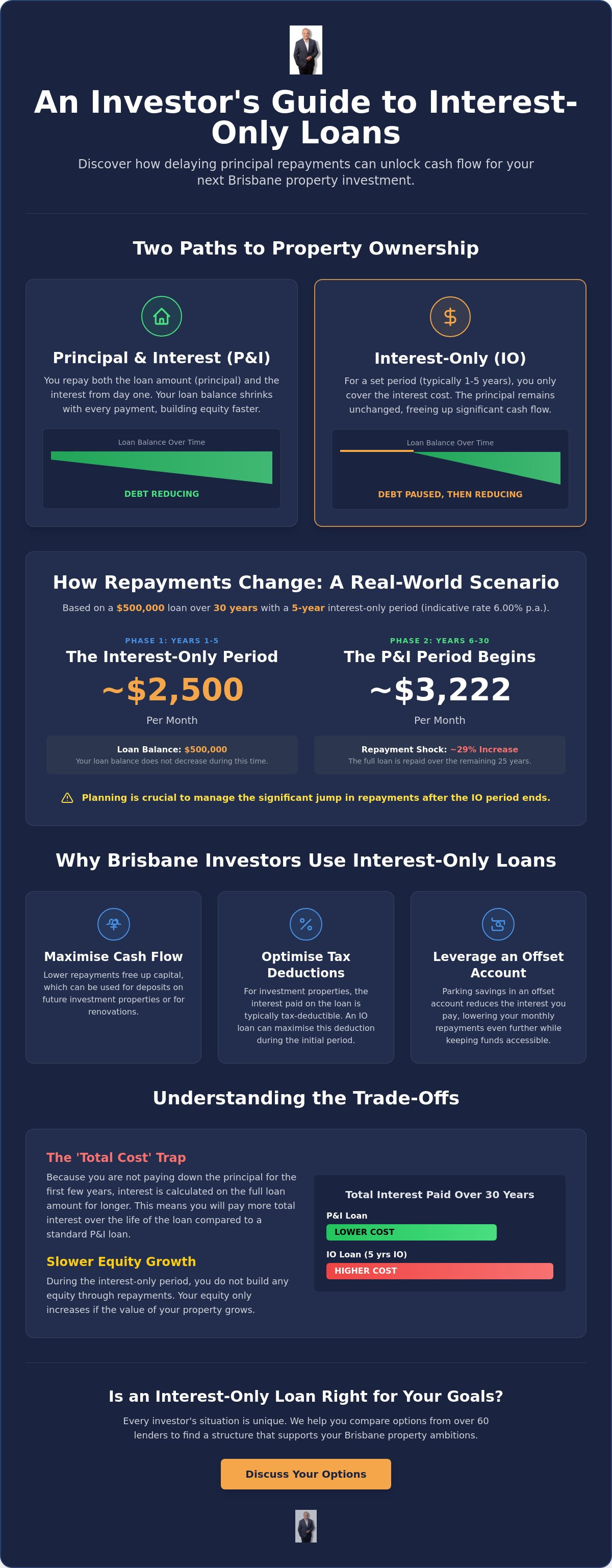
Your monthly bill looks smaller because you're skipping the part where you pay back the actual debt. It can feel like a massive relief for your budget. Just keep in mind that the debt stays the same size. If you borrowed $500,000, that balance doesn't move an inch during this period. A year later, you still owe exactly $500,000. It's not a discount on the loan; it's just a delay in paying the principal back. This keeps your cash flow healthy while you focus on other goals.
How the repayment structure works
Imagine your monthly bank statement. With a Principal and Interest (P&I) loan, your repayments look like a staircase stepping down as you chip away at the debt. With an interest only loan, that line stays perfectly flat. You're only covering the interest charges. Because you aren't touching the principal, your debt remains unchanged. An interest only loan is a temporary cash-flow strategy for Australian borrowers.
Common timeframes for Brisbane borrowers
Standard terms in Australia usually run from one to five years. For Brisbane investors, a five-year term is often the sweet spot. It offers time for property growth without high repayment pressure. We also see locals in South-East QLD use shorter periods for quick renovations or new builds. It's a flexible option; you can usually switch back to paying off the principal when your circumstances change.
How interest only repayments work in the real world
What does an interest only loan actually look like when you're checking your banking app on a Tuesday morning? For many Brisbane property owners, the most immediate change is a bit of breathing room in the family budget. Because you aren't paying down the principal, your required monthly payment is lower. This extra cash can be a lifesaver if you're trying to manage a growing portfolio or simply want to keep some funds aside for a rainy day. However, it's vital to ask: Is an interest-only loan right for you? The answer usually depends on how you plan to use that 'saved' money.
The bank still calculates interest daily, but they only ask you to cover that specific cost. Your original debt doesn't budge. This is why it feels easier on the wallet in the short term. You're effectively pausing the 'buying' part of your home ownership and just focusing on the 'holding' part. It's a strategic move, but it requires a bit of discipline to make sure that extra cash flow is working for you elsewhere.
The role of the offset account
Many of our clients use an offset account as their secret weapon. Think of it like a bucket of water sitting next to your loan. Any money you put in that bucket 'offsets' the debt, meaning the bank charges you less interest. The beauty of doing this during an interest only period is that your principal stays the same, but your monthly bill drops even further. It's a favourite move for Brisbane renovators who need quick access to cash for a new kitchen or deck. Andrew often suggests treating your offset like a safety net; it keeps your funds accessible while keeping your costs down. If you want to see how these numbers stack up for your specific situation, you can chat with us about your investment loan options.
The 'Total Cost' trap
While monthly costs are lower, the long-term cost of an IO loan is higher than P&I. Think of it like this: you're paying for the 'seat' in the car, but you aren't actually buying the car itself. Because that $500,000 debt isn't getting any smaller, interest is calculated on that full amount for longer. Over a 30-year loan term, this can add thousands to your total bill. It's a trade-off. You're choosing flexibility and cash flow today in exchange for a higher total cost over the life of the loan.
What happens when the interest only period ends? Most terms last five years. After that, the bank expects you to pay back the full debt over the remaining 25 years of a 30-year loan. This is called the 'residual' term. Because you have less time to pay back the same amount of money, your repayments will jump up significantly. It's not a surprise if you've planned for it, but it can be a shock if you haven't. Getting the timing right is where a bit of expert help makes all the difference.
Interest only vs principal and interest: Making the choice
Deciding between these two paths often comes down to your current stage of life. If your goal is to be debt-free as soon as possible, then Principal and Interest (P&I) is usually your best bet. You're chipping away at the debt from day one, which builds equity and saves you money in the long run. But what if you're an investor looking to grow your portfolio, or a homeowner facing a temporary change in income? That's where an interest only loan can step in as a helpful tool. It's not about which one is 'better' in a vacuum; it's about which one supports your lifestyle right now.
The Investor's Perspective
For many Brisbane investors, the choice is driven by tax. By only paying the interest, you can often maximise your tax-deductible expenses, which is a key part of negative gearing. It keeps your monthly costs lower, letting you put that extra cash towards your next deposit or perhaps a renovation. This strategy is a big reason why investor lending in Brisbane's unit market hit 40.3% recently. If you want to dive deeper into how this works for your portfolio, check out our Guide to Investment Property Loans.
The Homeowner's Perspective
Homeowners might use this option during a career break or while on maternity leave to keep costs manageable. It's a way to lower the pressure when your income takes a temporary dip. Banks are generally a bit stricter with owner-occupiers because they want to see that you have a solid reason for not paying down the debt. For a neutral look at the risks and benefits, the Australian Government's guide to interest-only loans is a great place to start. Having a plan for when the term ends is the best way to stay in control and keep your home journey stress-free.
Is an interest only period right for your Brisbane investment?
Brisbane is in a pretty unique spot right now. With dwelling values jumping 15.7% in the year to January 2026, many local owners are looking for ways to stay ahead of the curve. An interest only loan can be a powerful tool in this kind of market. It allows you to benefit from that capital growth without the heavy lifting of full principal repayments. If your property value goes up while your debt stays the same, you've built equity through market growth alone. It's a strategy that helps you keep your options open while the city continues to evolve.
Of course, there is a flip side to consider. If the market slows down, you aren't building any safety net through your own repayments. While experts forecast Brisbane house price growth between 5% and 11% for 2026, nothing is ever guaranteed. If prices stall, you're left with 'zero equity growth' because you haven't been chipping away at the principal. Andrew's approach to assessing your borrowing power is entirely non-judgmental. He'll help you look at your numbers to see if you have enough of a buffer to handle a quieter market comfortably.
Leveraging equity for your next Brisbane property
Want to grab a unit in West End or a character cottage in Paddington? By choosing an interest only period, you keep your cash 'liquid'. Instead of sinking every spare dollar into your current mortgage, you can save that principal for your next deposit. It's a common move for building a portfolio faster. You keep your non-deductible debt as low as possible and use your cash for the next move. You can read more about our approach to Investing in Brisbane Property to see how this might fit your long-term plan.
Navigating the 'Interest Only Cliff' in 2026
What happens when your interest only term actually ends? With APRA's new debt-to-income caps that started on February 1, 2026, the lending landscape has shifted slightly. Banks are now more restricted in how much high-debt lending they can take on. This makes it even more important to look at your options at least six months before your term expires. You might choose to refinance, try to extend the IO period, or prepare your budget for the switch to P&I. Talking to a broker early can save you from a nasty repayment shock. If you're feeling unsure about your next step, you can book a quick chat with Andrew to explore your options without any pressure.
How we help you navigate interest only options
Feeling a bit overwhelmed by the sheer number of choices out there? It is completely normal to feel that way. When you are looking for an interest only loan, the options can start to look like a blur of numbers and fine print. That is where we come in to make things simple again. Andrew takes the time to listen to your story first, without any judgment or high-pressure sales tactics. We believe that financial decisions are much easier to make when you feel comfortable and understood.
Andrew compares options from over 60 different lenders to find a fit that actually works for your specific Brisbane property goals. Whether you are looking at a big bank or a smaller, more flexible lender, we do the heavy lifting for you. We manage the 'bank talk' and handle the mountain of paperwork so you can focus on your life. Our service comes at no cost to you; the lenders pay us a commission for doing the work they would otherwise have to do themselves. It is a straightforward, transparent way to get the help you need.
The Brisbane City Home Loans difference
We aren't a faceless institution or an automated system. Andrew is a real person and a local guide who knows the Brisbane property market inside out. He understands the difference between an investment in Chermside and a renovation in Coorparoo. You won't find any confusing jargon here. We explain everything in plain English so you always know exactly where you stand. Andrew organises your entire application from the first chat right through to settlement, making the whole journey feel effortless.
Your next steps to financial clarity
Ready to see if an interest only loan is the right move for your next investment? Booking a chat is the easiest way to get some clarity. It is a free, no-obligation consultation where we can look at your numbers together in a relaxed environment. You don't need to have everything perfectly organised before we talk. Just bring a general idea of your goals and your current situation; it's often much less than you think! We are here to help you move forward with confidence. When you are ready, you can Organise a chat with Andrew about your home loan to get started.
Ready to find the right path for your Brisbane property?
Managing your mortgage shouldn't feel like a constant source of stress. Whether you're looking to boost your monthly cash flow or maximise your tax benefits, an interest only loan can be a strategic move for your investment journey. The most important thing is knowing how it fits into your life and having a clear plan for the future. You've now seen how the right structure can help you grow your portfolio while keeping your daily budget manageable.
You don't have to navigate these choices on your own. Andrew is here to help you compare options from over 60 different lenders, ensuring you find a competitive rate that matches your goals. With deep local expertise and a personalised, no-cost service, we take the hard work out of the application process. Ready to get some clarity? You can book a free home loan consultation with Andrew today. Let's work together to make your property dreams feel a lot more straightforward.
Common Questions About Interest Only Loans
Can I get an interest only loan for my first home in Brisbane?
Yes, you can, but lenders usually have stricter rules for first-home buyers. Most banks prefer you to pay down the debt on your own home from the start to build equity. However, if you have a temporary reason, like starting a family or a career change, it might be an option. It is best to check with a broker to see which lenders are open to this for owner-occupiers.
Are interest rates higher for interest only loans compared to P&I?
Yes, interest rates for an interest only loan are almost always higher than standard principal and interest rates. Lenders see these loans as slightly higher risk because the debt isn't being reduced over time. As of June 2026, you might see investor interest-only rates around 7.56% on average, while P&I rates sit closer to 6.95%. This price gap is something to weigh up against your monthly cash flow needs.
What happens at the end of the interest only period?
Your loan will automatically switch to principal and interest repayments once the period ends. Because you now have a shorter time to pay back the full debt, your monthly costs will increase significantly. For example, if you had a 5-year interest-only term on a 30-year loan, you now have only 25 years to pay it off. This is why planning for that jump is so important for your household budget.
Can I pay off the principal on an interest only loan if I want to?
Most lenders allow you to make extra payments toward the principal even during the interest-only period. However, some fixed-rate loans might have specific limits or fees for doing this. A great way to handle this is by using an offset account. You can park your extra cash there to reduce the interest you pay while keeping the money accessible for when you need it most.
Is an interest only loan good for tax purposes in Australia?
For many investors, this structure is a popular choice because it can maximise tax-deductible interest. By not paying down the principal, your deductible debt stays higher for longer, which can help with negative gearing strategies. However, tax rules are personal and can change. It is always a smart move to chat with your accountant to see how an interest only loan specifically impacts your Brisbane investment strategy.
How do I switch from interest only back to principal and interest?
You can usually switch back to principal and interest at any time by simply asking your lender. Most banks are happy to make this change because it reduces their risk as you start paying down the debt. You don't necessarily need to refinance to make this happen. A quick phone call or a message to your broker is often all it takes to get the process started and your new repayments confirmed.
Does an interest only loan affect my borrowing capacity for future properties?
It can definitely impact your borrowing power. Lenders often calculate your capacity based on what your repayments will be once the interest-only period ends. Since those future repayments are higher, it might look like you have less room in your budget for another loan. With the 2026 APRA rules capping high debt-to-income lending, having a clear strategy for your next move is more important than ever.
What is an 'interest only cliff' and should I be worried?
The 'cliff' is just a term for the sudden jump in repayments when your interest-only term expires. It isn't something to be worried about if you have planned for it well in advance. You can prepare by refinancing, selling the property, or simply adjusting your budget ahead of time. Andrew can help you look at these options six months before the switch happens so you aren't caught off guard by the change.


