

What if your bank is quietly charging you a "loyalty tax" just for staying put? It sounds backwards, but many local investors are paying up to 0.50% more than new customers walking in off the street. If you feel like your current loan is holding you back, you are certainly not alone. It is easy to feel a bit anxious about the 2026 property cycle or get tangled up in complex bank jargon. You just want to know your money is working as hard as you do.
I know how frustrating it is to watch your rental income disappear into high interest rates. You want a clear path to lower repayments and a way to unlock equity for your next deposit. That is exactly why I put this guide together. My goal is to show you how to refinance investment property brisbane so you can stop overpaying and start growing your portfolio again. With the right expert guidance, these big financial moves don't have to be overwhelming.
We will break down the latest market data, look at tax-efficient loan structures, and create a simple plan to get your equity moving. Whether you're navigating the new tax rules or just want a better deal, Andrew is here to help you make sense of it all without the stress.
Key Takeaways
- Identify if you're paying a "loyalty tax" and learn why the 2026 market shift creates a fresh opportunity to switch lenders for a better deal.
- Learn how to calculate and unlock the equity in your current home to fund your next deposit and grow your portfolio sooner.
- Understand why an offset account is usually the smarter, more tax-efficient choice compared to a redraw facility for savvy investors.
- Discover how to refinance investment property brisbane without the paperwork headache by letting Andrew compare over 60 lenders for you.
- Get a clear, step-by-step plan to lower your monthly repayments and keep more of your hard-earned rental income in your own pocket.
Why Refinance Your Brisbane Investment Property in 2026?
Have you ever felt like your bank is taking you for granted? It is a common feeling for local investors. You have been a reliable customer for years, yet you see the big banks offering lower rates to people who just walked through the door. This isn't just a hunch; it is a real financial hurdle called the "loyalty tax". If you want to refinance investment property brisbane, understanding this concept is the first step toward saving a lot of money and growing your wealth.
The Hidden Cost of the Loyalty Tax
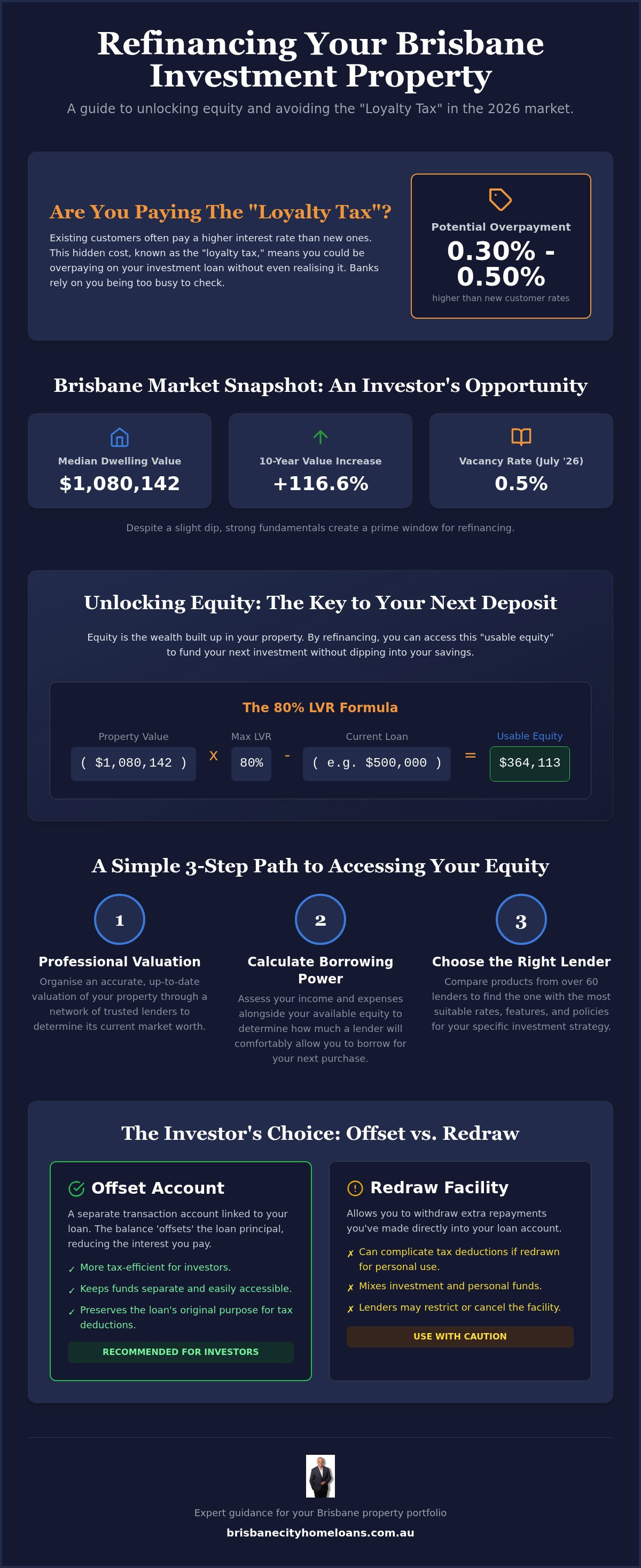
The loyalty tax is simply the premium paid by inactive borrowers who stay on older loan products. Lenders often bank on the fact that you are too busy to check your rate. Research shows this gap can be as high as 0.30% to 0.50% compared to what new customers get. When you consider the size of a standard investment loan, that small percentage adds up to tens of thousands over time. If you are curious about what refinancing means for your bottom line, it's essentially about forcing lenders to compete for your business again. Andrew can identify if you are being overcharged in just a few minutes, giving you the clarity you need to move forward without the guesswork.
Brisbane Market Update for Investors
The Brisbane property landscape has shifted as we move through 2026. While we saw a massive 116.6% increase in values over the last decade, the market is currently in a cooling phase. In August 2026, property values saw a 1.0% decline. However, the median dwelling value remains strong at $1,080,142. This slight dip actually creates a window of opportunity. With the RBA holding the cash rate at 4.35% in August, many lenders are hungry for quality investment loans and are offering sharper deals to attract them.
Rental yields are also a key part of the story. With vacancy rates at a record low of 0.5% in July 2026, your investment is likely performing well on the income side. By reviewing your loan now, you can align your repayments with the current market cycle. Whether your portfolio is focused on growth corridors like Moreton Bay or established inner-city units, 2026 is the year to ensure your loan structure isn't eating your profits. Andrew knows the local streets and the lenders, helping you navigate these bank games so you can focus on your next move.
Unlocking Equity: Funding Your Next Brisbane Investment
Think of equity as a hidden savings account tucked away in your walls. In plain English, it is simply the difference between what your property is worth today and what you still owe the bank. Even though Brisbane saw a small 1.0% value dip in August 2026, the median dwelling value is still sitting pretty at $1,080,142. If you bought a few years ago, you are likely sitting on a significant amount of wealth that could be the key to your next purchase.
When you refinance investment property brisbane, you can often perform what is called a "top-up". This allows you to borrow against that increased value to create a cash deposit for another investment. It is a powerful way to grow your portfolio without needing to save up a massive pile of cash from your salary. Before you dive in, it's always a good idea to weigh the costs and benefits of switching lenders to ensure the numbers truly stack up for your long-term goals.
The 80% LVR Rule for Investors
Lenders generally like to see you keep your Loan-to-Value Ratio (LVR) under 80%. Why? Because if you borrow more than that, they will usually charge you Lenders Mortgage Insurance. This is an extra cost that protects the bank, not you. You can find your "useable" equity with a bit of simple mental maths. Just take 80% of your property's current value and subtract your current loan balance. The leftover amount is what you can potentially use for your next deposit while keeping your primary residence safe and your costs low.
Steps to Accessing Your Equity
Accessing these funds doesn't have to be a headache. Andrew follows a straightforward path to get you moving:
- Step 1: Get a professional valuation. Andrew organises this through his network of lenders. He knows which ones are currently offering fair valuations in the 2026 Brisbane market, which can vary wildly between suburbs.
- Step 2: Calculate your borrowing power. Once we know your equity, we look at your income and expenses to see how much a lender will actually let you borrow for property number two or three.
- Step 3: Choose the right lender. Every bank has different rules for investors. Andrew compares over 60 lenders to find the one that supports your specific growth strategy.
Getting an accurate valuation is the foundation of this whole process. If you are curious about what your portfolio is really capable of, Andrew can run the numbers for you to see how much equity you could safely unlock today.
Choosing the Right Features: Offset Accounts vs. Redraw
When you look to refinance investment property brisbane, it is incredibly easy to get stuck on the interest rate. We all want the lowest number possible, don't we? But for an investor, the way your loan is built matters just as much as the rate itself. If your loan structure is clunky, you might save a few dollars on interest but lose thousands in tax deductions. Andrew takes the time to explain these bits because he wants your portfolio to be as efficient as possible.
The Offset Account Advantage
An offset account is essentially a regular transaction account that sits alongside your loan. The balance in the account is "subtracted" from your loan balance before the bank calculates your interest for the day. It is a fantastic place to park your rental income or your tax return. You keep your cash perfectly accessible for things like a new roof or a quick renovation, but you aren't paying interest on that amount in the meantime. Most Brisbane investors find this a no-brainer because it keeps the finances clean and the tax man happy. While some lenders might charge a small fee for an offset, the interest savings usually far outweigh the cost.
Redraw Facilities: What to Watch Out For
Redraw facilities are a bit different and can be a bit of a "tax trap" for the unwary. They allow you to pull back any extra payments you have made directly into the loan. While this sounds fine on the surface, it can cause a real headache. If you redraw funds to pay for a personal expense, like a family holiday or a new car, you might "contaminate" the loan. The ATO generally views that redrawn portion as a new loan for a personal purpose. This means you can no longer claim the interest on that part as a tax deduction. It is a mess that can take years to unpick. This is why Moneysmart's guide to refinancing is such a handy resource; it helps you understand the risks of different loan types before you commit.
Andrew’s checklist for choosing between the two is simple. If you value flexibility and want to keep your accountant happy, the offset is usually the winner. However, if you are a "set and forget" investor and want the absolute lowest fees possible, a basic loan with redraw might work, provided you never touch the extra payments for personal use. Andrew compares over 60 lenders to find the specific feature set that matches your 2026 investment strategy.
The Refinance Process: How Andrew Makes It Stress-Free
Let's be honest. Nobody wakes up on a Saturday morning excited to fill out bank forms. The thought of digging through dusty folders or scanning endless PDFs is often enough to make people stay with a bad loan for years. It is the number one reason investors pay that "loyalty tax" we talked about earlier. But when you refinance investment property brisbane with a local guide, the process becomes remarkably simple. Andrew is here to handle the paperwork so you can focus on your weekend.
Andrew’s 4-Step Refinance Roadmap
We have refined the process into four clear stages. It is designed to be fast, transparent, and completely low-pressure:
- Step 1: The Discovery Call. We start with a quick, friendly chat. Andrew listens to your goals for 2026, whether that is slashing your interest rate or unlocking equity for your next deposit.
- Step 2: The Comparison. This is where Andrew does the hard work. He sifts through more than 60 lenders to find the specific products that actually fit your situation.
- Step 3: The Application. Once you choose a path, we take over. We package up your application and handle all the back-and-forth with the bank's bureaucracy.
- Step 4: Settlement. Your new loan is finalised. You can enjoy your improved rate and a structure that finally works for you.
What Documents Do I Need?
You might be surprised by how little you actually need to get the ball rolling. Most lenders in 2026 are quite digital, which makes life easier. To get your "ducks in a row", you'll generally just need your two most recent pay slips, your latest rental statements, and your current loan balances. Andrew uses secure digital tools to verify your information quickly, which means less time hunting for paper and more time moving forward. From that first chat to the day your loan settles, the whole journey typically takes about four to six weeks.
The best part? This personalised service comes at no cost to you, as Andrew is paid by the lender you choose. If you are ready to see how your portfolio could perform with a better structure, reach out to Andrew for a free consultation today.
Ready to Grow Your Portfolio? Talk to Andrew Today
Brisbane's property market in 2026 is full of mixed signals. We have seen a slight 1.0% dip in values recently, yet the rental market remains incredibly tight with a 0.5% vacancy rate. If you have been sitting on the fence, now is the time to check if your current loan is still fit for purpose. Refinancing isn't just a simple transaction; it is a strategic move to protect your cash flow and prepare for your next purchase. You have worked hard to build your portfolio, so don't let a "loyalty tax" or a clunky loan structure quieten your success.
When you decide to refinance investment property brisbane, you deserve more than a generic call centre experience. You need someone who understands the local streets, from the high-growth corridors in Moreton Bay to the established unit markets in the inner city. Andrew provides that local expertise, combined with a genuine desire to see you succeed. He takes the stress out of the equation by doing the heavy lifting, comparing the market, and handling the bank's bureaucracy on your behalf.
Why Brisbane City Home Loans?
Working with Andrew means you get a personalised partnership rather than a faceless institution. While a big bank will only ever show you their own products, Andrew has access to over 60 lenders. This includes the big four banks, but also boutique lenders that often have much more flexible rules for property investors. Whether you need a specific offset structure or a higher valuation to unlock equity, Andrew knows which lender is likely to say "yes".
Best of all, this service comes at no cost to you. Andrew is paid a commission by the lender you choose, which means you get expert, independent advice without adding another expense to your portfolio. It is a completely transparent way to ensure you are always getting a fair deal. Andrew’s commitment is to find the loan that fits your life and your 2026 goals, not the bank’s profit margins.
Book Your Free Consultation
The 2026 Brisbane property market is moving fast, and waiting another six months could mean missing out on significant interest savings or the chance to secure your next deposit. Why keep paying more than you have to? Andrew is ready for a no-pressure, friendly chat to see what is possible for your situation. There is no judgment and no obligation; just clear, plain English advice from a local who cares.
Stop letting the banks take your loyalty for granted. It only takes a few minutes to find out if you could be saving thousands of dollars every year. Get in touch with Andrew for a free refinance review today and take the first step toward a stronger, more profitable property portfolio.
Take Control of Your Brisbane Property Future
You have put in the hard work to build your portfolio. Now is the time to make sure your bank is working just as hard for you. By choosing to refinance investment property brisbane, you can ditch the loyalty tax and set up a loan structure that actually fuels your growth. Whether you are unlocking equity for your next deposit or simply cleaning up your tax structure with a proper offset account, every small change adds up to massive long-term gains.
You don't have to navigate the 2026 market alone or get buried in paperwork. Andrew is here to handle all the legwork, sifting through over 60 lenders to find the right fit for your specific goals. Since the lenders pay us, this expert guidance comes at no cost to you. It is a simple, stress-free way to ensure your money stays in your pocket where it belongs.
Book a free, no-obligation refinance review with Andrew today. Your next big property move is closer than you think; we can't wait to help you make it happen.
Frequently Asked Questions
Is it worth refinancing an investment property for a 0.5% lower rate?
Yes, it is often very worth it. A 0.5% drop on a standard investment loan can save you thousands of dollars in interest every single year. This extra cash flow can be used to pay down your principal faster or save for your next deposit. When you decide to refinance investment property brisbane, Andrew looks at the total cost of the switch to make sure the savings are real.
How much does it cost to refinance an investment property in Brisbane?
You should generally budget between $500 and $2,000 for a standard refinance. These costs typically cover your current bank's discharge fee, new application fees, and government registration fees. While there are upfront costs, the long-term interest savings often pay back these fees within the first year. Andrew helps you compare these costs against the potential savings so you can make a clear, stress-free decision.
Can I refinance my investment loan if it is currently fixed?
You certainly can, but you'll need to check for break fees first. Lenders often charge a fee if you leave a fixed contract early. Andrew can help you calculate if the lower interest rate on a new loan will save you more money than the cost of the exit fee. Sometimes it makes sense to wait until the fixed term ends, but other times, switching early is the smarter financial move.
How long does the refinance process typically take with a broker?
The process usually takes between four and six weeks from your first chat to the final settlement. This timeline can vary depending on how fast your current bank processes the discharge paperwork. Because Andrew does the legwork and compares over 60 lenders for you, the actual time you spend on the application is kept to a minimum. We use digital tools to keep things moving quickly and smoothly.
Will refinancing my investment property affect my tax deductions?
Yes, it can, so it's vital to get the structure right. Interest on an investment loan is generally tax-deductible as long as the funds are used for the property. However, if you use a redraw facility for personal spending, you might lose some of those deductions. This is why Andrew often recommends an offset account. It keeps your finances clean and ensures your tax accountant stays happy during tax season.
Do I need a new deposit to refinance my Brisbane property?
Not at all. When you refinance, your deposit is actually the equity you have built up in the property. As long as your loan balance is less than the current market value, you have equity to work with. In the 2026 Brisbane market, many investors are using this equity to secure a better rate or even pull out cash for their next purchase without needing to save a new deposit.
Can Andrew help me if I am self-employed?
Absolutely. Andrew understands that being self-employed often means your income doesn't look like a standard pay-slip. He has access to over 60 lenders, including many who specialise in loans for business owners. Whether you have full financials or need a more flexible approach, Andrew knows which lenders are most welcoming to self-employed Brisbane locals. He will guide you through exactly what documents you need to succeed.
What is the maximum LVR for an investment refinance in Australia?
Most lenders will allow you to borrow up to 90% of the property's value, but you'll usually have to pay Lenders Mortgage Insurance (LMI) if you go above 80%. For most investors, 80% is the magic number because it avoids those extra insurance costs. Andrew will help you look at your current property value to see where you sit and which lenders offer the best terms for your specific situation.


