

What if the most stressful part of building your Brisbane dream home wasn't the actual construction, but the mountain of paperwork behind it? It's a common worry. Most people feel a bit shaky when they start looking at a construction loan, especially with the fear of a builder hitting a rough patch or the confusion of paying for a house you can't live in yet. You want to focus on choosing tiles and floor plans, not worrying if your bank and builder are on the same page.
I get it. Managing rent while your new home is just a frame in the dirt feels like a massive juggle. This guide is here to take that weight off your shoulders. You'll learn exactly how the process works in 2026, from navigating progress payments to understanding the latest council approvals and the $30,000 First Home Owner Grant. We'll break down the build timeline, show you how to find flexible payment stages, and explain how to secure a sharp interest rate so you can build with total confidence.
Key Takeaways
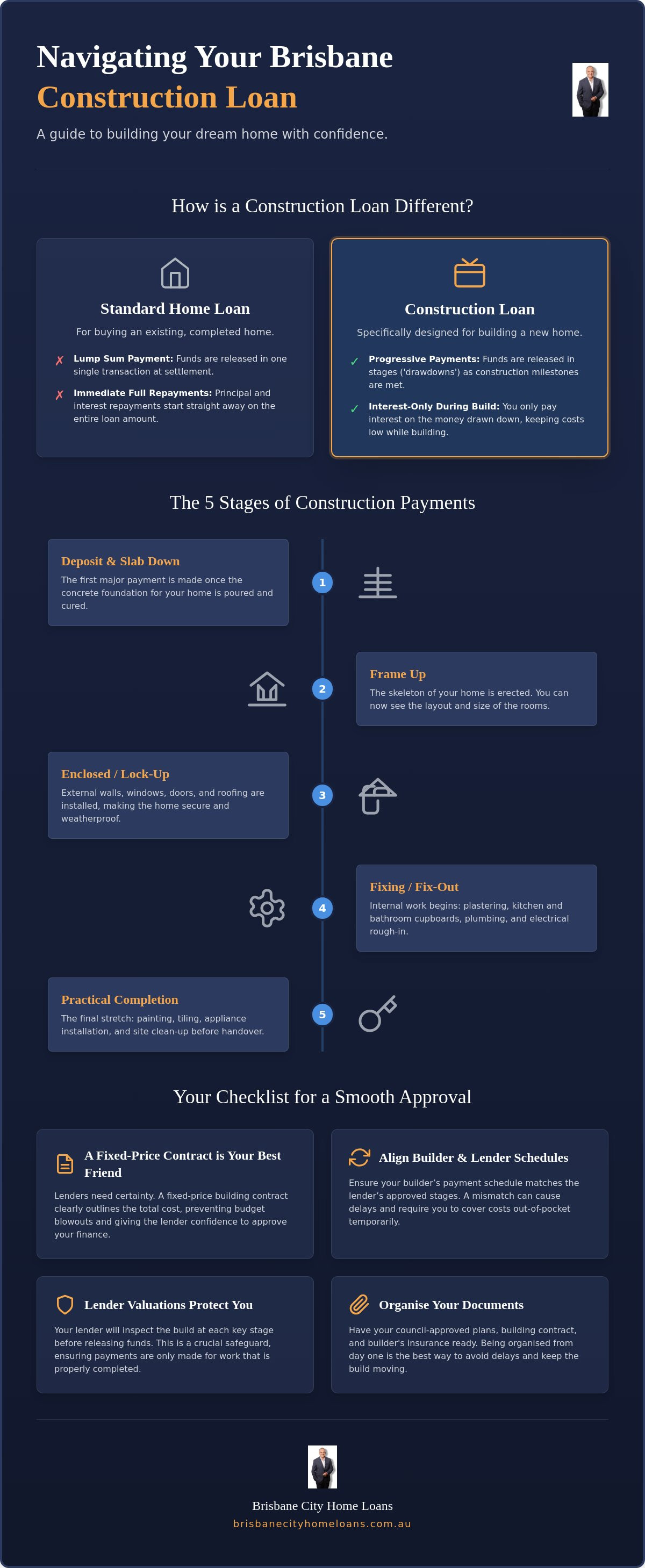
- Learn why a construction loan works differently than a standard mortgage by releasing funds in stages as your new home takes shape.
- Get a clear look at the five building stages to help you manage progress payments and keep your builder on track.
- Understand the paperwork lenders really want to see, including why a fixed-price contract is your best friend when seeking approval.
- Discover how to find a lender whose payment rules actually align with your builder’s schedule to avoid out-of-pocket stress.
- Compare the pros and cons of new builds versus knock-down rebuilds to find the right path for your Brisbane project.
What is a Construction Loan and How Does it Differ From a Standard Mortgage?
Think of a standard mortgage like buying a finished cake from a bakery. You pay the full price, you get the whole cake, and you start your full repayments immediately. A construction loan is more like paying for that cake as the baker buys the flour, bakes the layers, and finally adds the icing. It’s a specialised type of finance designed specifically for people building a new home from scratch rather than buying one that is already standing on a block in suburbs like Chermside or North Lakes.
A construction loan is a progressive finance facility that aligns with a builder's construction schedule. Instead of getting a lump sum at the start, your lender releases the money in "draws" or stages. This is the biggest difference. While a standard mortgage settles in one go, this loan stays flexible as your project grows from a patch of dirt to a finished front door. It means you aren't paying for a roof until the roof actually exists.
The Magic of Interest-Only Repayments
One of the biggest worries for Brisbane families is how to afford a mortgage while they're still paying rent or another loan elsewhere. Most lenders solve this by offering interest-only periods during the build, often lasting up to 24 months. This means your monthly "holding costs" stay much lower while your home is just a concrete slab or a timber frame. You only pay interest on the portion of the loan that has actually been paid to the builder. Once the keys are in your hand and the build is 100% finished, the loan usually transitions into a standard principal and interest repayment plan.
Progressive Drawdowns: The Heart of the Loan
The system of "drawing down" funds is there to protect you. Your lender won't just take the builder's word for it that the work is done. Usually, the bank will send out a valuer to inspect the site at key milestones. They check that the slab is poured or the roof is on before any cash changes hands. This ensures your builder is only paid for work that has actually been completed to a professional standard. It keeps everyone honest and ensures you aren't left out of pocket if things slow down on site. It is a bit of extra admin, but it is the best way to keep your project on track and your budget safe.
The 5 Stages of Building: How Progress Payments Work in 2026
Ever wondered how the money actually moves from the bank to your builder? It doesn't happen all at once. In Queensland, your construction loan follows a very specific rhythm called the "schedule of payments." This is a list of milestones agreed upon in your building contract. Before you sign anything, it's vital to check that your builder’s requested payment stages match what your lender is willing to pay. If your builder wants 20% for the slab but your bank only allows 10%, you could be left scrambling for the difference. Staying organised with your documents from day one is the best way to avoid these awkward gaps.
When a stage is finished, your builder will send you an invoice. You'll sign a "progress claim" form and send it to your bank. They then release the funds directly to the builder. It’s a simple process, but delays often happen if the paperwork isn't quite right or if the bank's valuer can't get on-site quickly. Being proactive and keeping a clear line of communication with both your builder and your lender will keep the wheels turning.
From Slab to Practical Completion
Building a home is like a five-act play. In the Brisbane market, these stages are fairly standard under QBCC regulations. Here is how it usually unfolds:
- Stage 1: Deposit and Slab. You pay the initial deposit to get things moving, and then the first big payment happens once the concrete slab is poured and cured.
- Stage 2: Frame. This is when the skeleton of your home goes up. It’s an exciting stage because you can finally see the layout and size of the rooms.
- Stage 3: Enclosed/Lock-up. Once the windows, doors, and roofing are in, your home is "locked up" and weather-proof. This is a major milestone for your peace of mind.
- Stage 4: Fixout. This covers the internal work. Think plastering, cupboards, and the first bits of plumbing and electrical.
- Stage 5: Practical Completion. This is the final stretch where the painting is finished, the appliances are installed, and the site is cleaned up.
The Final Inspection and Settlement
When the builder is nearly done, they’ll issue a "Notice of Practical Completion." This isn't just a friendly heads-up; it’s a formal trigger for your final construction loan payment. Before that last bit of money is released, your bank will order a final valuation. They want to be 100% sure the house is finished as planned and is worth what they've lent you. You’ll also need to show proof of building insurance before you get the keys. If you're feeling a bit overwhelmed by the back-and-forth, having a local expert to manage the lender side can make the final handover feel much smoother.
Comparing Your Options: New Build vs. Knock-Down Rebuild vs. Major Renovation
Deciding how to get your dream home is a huge first step. In Brisbane, you have basically got three paths: buying a fresh block, knocking down an old place, or giving your current house a massive makeover. It is worth knowing that banks look at these very differently. A construction loan for a vacant lot in a new estate has a different risk level than a project where you are ripping the roof off a 1920s Queenslander. Lenders are naturally cautious. They need to be sure the final value of the property will cover the debt once the dust settles.
If you are going for a new build, you are usually looking at two separate settlements. With the average cost of residential land in Brisbane sitting at $716,000 in late 2024, many families choose to secure the dirt first. You settle on the land, then you settle on the building contract later. This gives you breathing room to get your plans approved by the council while you hold the land. It is a clean way to start, but it does mean managing two sets of paperwork and two separate loan approvals.
The Knock-Down Rebuild Strategy in Brisbane
This is becoming the go-to move in leafy suburbs like Ashgrove or Camp Hill. Why? Because finding a vacant block of land there is like finding a needle in a haystack. Instead of moving further out, people buy a "fixer-upper" just for the block. The beauty of this is using the equity in the land you already own. If your block has gone up in value, that "paper wealth" can often serve as your deposit for the new build. Just remember you will need a plan for where to live while the old place is a pile of bricks. Renting while paying a loan can be a squeeze. We always look for lenders with the best interest-only terms to keep your cashflow healthy during the "gap" months.
Renovation Loans: Structural vs. Cosmetic
Not every home improvement needs a full-blown construction loan. If you are just doing a new kitchen or painting the bedrooms, a simple home renovation loan or a top-up on your existing mortgage is usually enough. The "structural trigger" is what changes things. As soon as you start moving walls, adding a second storey, or changing the footprint of the house, lenders will insist on a construction facility. They want to see council-approved plans and a fixed-price contract. They do this because they need to value the house "as-completed" to make sure the renovation actually adds enough value to the property to justify the loan.
Getting Your Paperwork Sorted: What Lenders Look for in a Building Contract
Why are banks so picky when it comes to a construction loan? It's simple. They are lending you a lot of money for something that doesn't actually exist yet. If you buy an established house in Paddington, the bank has a physical building as security. If you’re building, they just have a promise and a pile of dirt. This makes them extra cautious about the details. They want to be certain that the project will actually be finished and that it will be worth the money they’re handing over.
The most important document you’ll need is a "Fixed Price Building Contract." Banks generally hate "cost-plus" contracts because the final price is a moving target. They want to see a locked-in figure so there are no nasty surprises halfway through. You also need to be careful with "variations." These are the changes you make after the contract is signed, like upgrading your bathroom tiles or adding extra power points. Most lenders won't increase your loan for these small tweaks, meaning you’ll have to find the cash yourself. It’s much easier to get your "wish list" into the initial contract from the start.
In Queensland, your builder must have QBCC Home Warranty Insurance. This protects you if the builder goes bust or does dodgy work. Your lender will check this before they even think about approving the first payment. If the insurance isn't in place, the money stays locked in the vault.
The Essential Document Checklist
Getting your "ducks in a row" early will save you weeks of back-and-forth. Here is what you’ll need to hand over to your broker or bank:
- Council-approved plans: A full set of drawings with the Brisbane City Council (or your local SEQ council) stamp of approval.
- A signed contract: This must include a clear schedule of progress payments that matches your lender’s rules.
- Builder's details: Proof of their current license and their Queensland Home Warranty Insurance (QBCC) certificate.
- Specifications: A detailed list of the materials and finishes being used in the home.
Navigating the Valuation Gap
Sometimes, the bank’s valuer might decide your finished home will be worth less than what it costs to buy the land and build the house. This is called a "valuation gap." It often happens if you’re building the best house on the street or if land prices have shifted. If this happens, you might need to tip in a bit more of your own cash or look for a different lender who sees more value in the project. Understanding how much deposit do i need for a home loan can help you prepare for these scenarios before they become a problem. If the paperwork is starting to feel like a second job, let Andrew at Brisbane City Home Loans take the admin off your plate so you can focus on the fun parts of your build.
Why Working with a Brisbane Broker Beats Going Straight to the Bank
Walking into a big bank for a construction loan can feel a bit like trying to fit a square peg into a round hole. Most banks have very rigid rules that don't always play nice with the reality of building a home. For example, if your builder needs a 10% deposit for the slab but your bank’s policy only allows 5%, you are the one left stuck in the middle. It’s a frustrating spot to be in, especially when you just want to see your house start taking shape. This is where having a local guide makes all the difference.
Andrew looks at over 60 different lenders to find the one whose progress payment rules actually match your builder’s contract. Instead of you having to change your plans to suit the bank, we find a bank that suits your plans. We also bring deep local knowledge to the table. We understand the Brisbane City Council approval timelines and how they can impact your loan expiry. If the council takes an extra month to tick off your plans, we make sure your finance doesn't fall through the cracks. The best part? Andrew’s service is at no cost to you because the lender pays the commission once your loan settles.
Andrew’s Personal Touch on Your Build Journey
Building a home involves a lot of "he said, she said" between the bank, the builder, and the valuer. It can quickly become a full-time job just keeping everyone on the same page. We step in to manage that back-and-forth for you. We handle the admin and the follow-ups so you can focus on your actual life. We also do regular check-ins to ensure your progress payments are being processed on time. This is vital because it stops your builder from charging late fees or, worse, stopping work on-site. If you want to see what’s available right now, we can help you get a mortgage quote from dozens of lenders in one go.
Beyond the Build: Your Long-Term Finance Partner
Our relationship doesn't just end the moment you get your keys and move in. Once the dust has settled and the construction phase is over, we review your loan again. We want to make sure you are still on a competitive rate now that you’ve transitioned to a standard mortgage. We can also help you set up things like offset accounts. These are great for saving on interest once you start making full repayments. For a broader look at how we help people across the city, you might find our guide on home loans brisbane helpful. We are here to make sure your home remains a dream, not a financial burden.
Ready to Lay the First Brick?
Building a home is one of the biggest adventures you'll ever take. It doesn't have to be a mountain of stress, though. By now, you know that a successful construction loan is all about getting your timing right. From matching your progress payments to your builder’s schedule to ensuring your paperwork meets the bank's strict requirements, every little detail helps keep the project moving. You've seen how the five stages of building work and why a fixed-price contract is your best friend when it comes to getting that all-important approval.
You don't have to do this alone. Andrew is here to compare 60+ lenders in one session, finding the one that actually fits your specific project and budget. We provide expert guidance on Brisbane building contracts and handle the back-and-forth with the bank so you can focus on the fun parts of your new home. Our service is at no cost to you, as the lender pays the commission. Why not take the first step toward your new front door? Book a free building consultation with Andrew today and let's get your build started with confidence.
Frequently Asked Questions
Can I get a construction loan if I already own the land?
Yes, you absolutely can. If you already own your block in Brisbane, you can use the equity in that land as your deposit for the building phase. This often means you won't need to tip in as much cash from your savings because the bank sees the land as your contribution to the project. It’s a great way to get started if you’ve been sitting on a block while saving for the build.
Do construction loans have higher interest rates than standard mortgages?
Generally, yes, they can be slightly higher than standard home loans. In July 2026, variable rates for owner-occupiers starting around 5.89% p.a. were common. Because these loans are more complex for the bank to manage, they often come with a small premium. The good news is that you only pay interest on the money you've actually spent at each stage of the build, which keeps your costs lower during construction.
How much deposit do I need for a construction loan in Queensland?
You typically need a 20% deposit to avoid paying Lenders Mortgage Insurance (LMI). However, many lenders will look at projects with as little as a 5% or 10% deposit. If you are a first home buyer, you might be able to use specific government schemes to help bridge the gap. This means you don't always need a massive pile of cash to get your project off the ground.
What happens if the building costs increase mid-way through the project?
This is where things get tricky. If you have a fixed-price contract, the builder usually wears the cost of rising materials. However, if you choose to change the plans mid-build, you will likely have to pay for those variations out of your own pocket. Banks rarely increase a construction loan once the first slab payment has been made, so it’s vital to get your budget right from the start.
Can I use the First Home Owners Grant (QLD) as part of my deposit for a construction loan?
Yes, the $30,000 First Home Owner Grant can be a huge help. For contracts signed from July 1, 2026, you can apply this grant toward your deposit as long as the total value of the land and build is under $750,000. It is a fantastic way to lower your initial borrowing amount and make the dream of a new home much more achievable for first-time buyers in Queensland.
How long do I have to finish building my house once the loan is approved?
Most lenders expect you to finish the project within 12 to 24 months. They usually include a "sunset clause" in your loan agreement that sets a deadline for completion. If construction drags on longer than this, you might need to re-apply for the loan or ask for a formal extension. This can sometimes involve extra fees and updated valuations, so keeping your builder on schedule is important.
Can I be an owner-builder with a construction loan?
It is possible, but it’s much harder to find a lender. Most banks prefer the security of a licensed builder with a fixed-price contract. In Queensland, you need an owner-builder permit for any work valued at more than $11,000. Even with a permit, many banks will only lend a lower percentage of the home's value, meaning you would need a significantly larger deposit to get approved.
What is the difference between a land loan and a construction loan?
A land loan is just for the block of dirt, while a construction loan covers the actual house. Many people settle on the land first with a land loan and then add a construction facility later once they have their building contract and council-approved plans ready to go. You can often bundle them together, but they are technically two different parts of your finance journey.


