

What if the "value" of your home isn't actually what the bank says it's worth on paper? It's a bit of a trick question. While Brisbane dwelling values have soared by 17.4% over the last year, that big number on your valuation doesn't mean you can spend it all tomorrow. You've probably heard the term home equity tossed around, but between confusing talk of LVRs and the latest 2026 interest rate shifts, it's easy to feel more overwhelmed than empowered.
I get it. You want to use what you've built to get ahead, but you don't want to risk the roof over your head or get stuck talking to a robotic bank call centre. This guide is here to clear the air. I'll show you how to find your "usable equity" figure, which is the only number that really matters for your next move. We'll break down exactly how much you can safely borrow under the new APRA rules and map out a stress-free plan to grow your wealth in the current Brisbane market. It's time to turn that paperwork value into a real-world plan.
Key Takeaways
- Learn why your home's paper value isn't the same as what you can actually spend, and how recent Brisbane growth changes the game.
- Master the "80% Rule" to calculate your usable home equity so you can plan your next move with total confidence.
- Explore how to fund a "Queenslander" upgrade or jump into the South-East Queensland investment market using what you already own.
- Get a simple plan to manage your budget against 2026 interest rates while keeping your family home safe.
- See how comparing 60+ lenders with Andrew at Brisbane City Home Loans makes the whole process feel like a chat with a mate rather than a bank audit.
Home Equity 101: What Is It and Why Does It Matter?
Think of your home as a giant piggy bank sitting right in the middle of your street. Every time you make a mortgage payment, you're dropping a few more coins into that bank. But in Brisbane lately, it feels like someone else is also dropping $50 notes in there while you sleep. So, what is home equity? Put simply, it's the bit of the house you actually own. If you sold your place today and paid the bank back every cent you owe them, the cash left over in your pocket is your equity. It's essentially a savings account you've been filling up without even trying.
Why does 2026 feel like such a unique moment for Brisbane homeowners? We're right in the middle of a fascinating property cycle. Dwelling values across the city jumped by 17.4% in the last 12 months alone, meaning your home equity has likely grown much faster than your bank balance. Your equity grows in two distinct ways. First, there's the steady progress you make by paying down the principal of your loan. Second, there's the heavy lifting the market does for you when property prices rise. In a fast-moving market like ours, that second factor can do decades of work in just a few years.
How to Determine Your Current Property Value
You've probably spent a Friday night browsing those online estimator sites. They're a great starting point, but they aren't a bank-ready figure. A website algorithm doesn't know you've just polished the floorboards or that a new boutique cafe opened at the end of your road. To get a real number, you need a professional bank valuation. This is where a human expert looks at your property and compares it to recent sales in your specific pocket of Brisbane. With the median house value now sitting at $1,225,350, even a small 2% difference in a valuation can change your financial plans by tens of thousands of dollars. Local infrastructure projects tied to the 2032 preparations are also shifting values suburb by suburb, making local knowledge more important than ever.
The Difference Between Total and Usable Equity
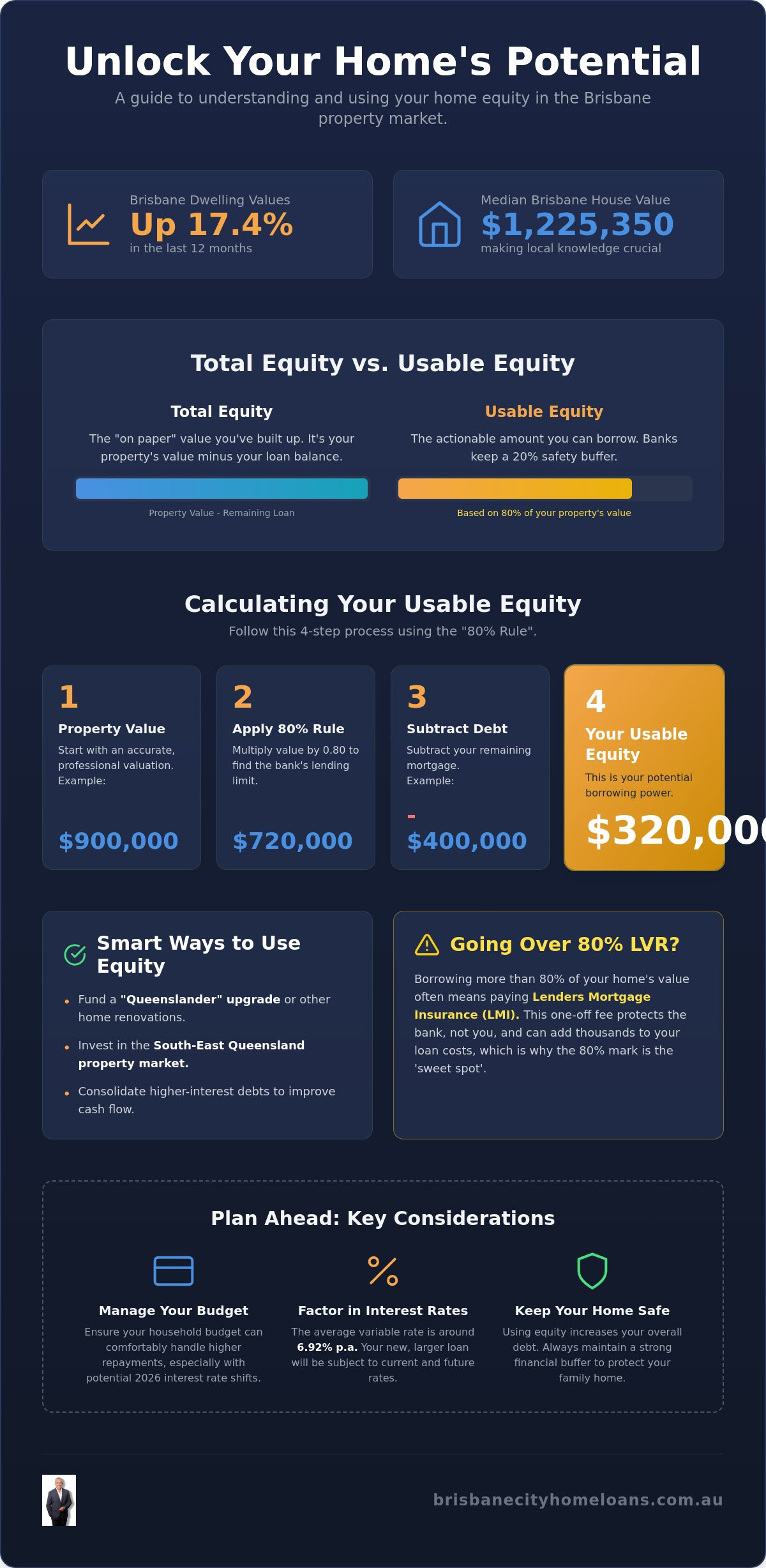
Usable equity is the specific amount of home equity you can actually borrow against for things like renovations or an investment property. It's a common trap to think you can spend every cent of the value you've built up. Sadly, it doesn't quite work that way. Total equity is your "paper" value, the big number that looks impressive on a statement. Usable equity is your "actionable" value. Banks usually won't let you touch the last 20% of your home's value. They keep this as a safety buffer to ensure that if the market dips, you don't end up owing more than the house is worth. We'll look at the exact maths of this 80% rule in the next section.
Calculating Your "Usable" Equity (The 80% Rule)
You've seen the prices in your street go up. You know there's value there. But how do you actually get a number you can take to the bank? In the world of Australian lending, everything revolves around your Loan-to-Value Ratio, or LVR. It sounds like jargon, but it's just a fancy way of asking: "What percentage of the house does the bank still own?" Understanding this ratio is the secret to unlocking your home equity without getting hit by unexpected costs.
The 4-Step Calculation Process
Let's look at a real-world example to make this feel more tangible. Imagine you own a property in Coorparoo. It's a great spot, and after the recent market jump, it's now worth $900,000. You still owe the bank $400,000 on your original mortgage. Here is how you find your usable equity:
- Step 1: Get a realistic valuation. We'll use our $900,000 figure for this example.
- Step 2: Multiply that by 0.80. This gives you $720,000, which is the "safe" limit banks prefer to lend against.
- Step 3: Subtract your current debt. $720,000 minus your $400,000 mortgage leaves you with $320,000.
- Step 4: That $320,000 is your "usable" figure.
This is the amount you could potentially use for strategically using your home's value to grow your wealth. However, keep in mind that any extra money you borrow becomes part of a new loan. You'll need to make sure your household budget can handle the extra repayments at 2026 interest rates. With the average variable rate currently sitting around 6.92% p.a., it pays to be precise with your maths before you dive in.
What Happens If You Go Over 80% LVR?
Can you borrow more than that 80% mark? You certainly can, but it comes with a catch called Lenders Mortgage Insurance (LMI). This is a one-off fee that protects the bank, not you, in case you can't make your repayments. It can cost thousands of dollars, which is why staying under that 80% "sweet spot" is usually the goal for most Brisbane families. It keeps your costs down and your options open.
Exceeding the limit doesn't just add the insurance cost. It often pushes you into a higher interest rate bracket because the bank sees the loan as higher risk. If you're unsure where your numbers sit, it's often worth having a quick, non-judgmental review of your current loan to see what's actually possible for your situation. Most people find they have more breathing room than they first thought once we strip away the bank's complex spreadsheets and look at the real home equity sitting in their bricks and mortar.
Smart Ways to Use Your Equity in Brisbane
So, you've crunched the numbers. You know you have some usable home equity sitting there. Now comes the exciting part: what do you actually do with it? Think of this value as a tool. When used correctly, it can help you skip years of saving and jump straight into your next big goal. Whether you want to grow your family's wealth or just make your daily life a bit more comfortable, Brisbane offers some unique opportunities to put that value to work.
Buying a Second Home or Investment Property
Buying an investment property is a classic move for a reason. With Brisbane rental vacancy rates sitting at a tiny 0.9% as of May 2026, the demand for quality housing is higher than ever. The best part? You don't necessarily need a pile of cash for a deposit. You can use your home equity as a guarantee for the new loan. This allows you to keep your cash in the bank for emergencies while still growing your property portfolio.
However, you need to be careful of the "cross-collateralisation" trap. This is a fancy way of saying the bank ties your current home and your new investment together in one big knot. It sounds convenient, but it can make things very messy if you want to sell one property later or switch lenders. A local broker can help you structure these loans separately so you stay in control. If you are looking to use your equity to help a family member get a leg up, our First Home Buyers QLD guide covers the latest 2026 grants and schemes that can work alongside your support.
Funding Renovations and Home Improvements
Maybe you love your suburb but your house is starting to feel a bit small. Using your equity for a "Queenslander" upgrade, like adding a massive back deck or a new master suite, is often much cheaper than a personal loan. Since the interest rate on a home loan is significantly lower than most other types of credit, it's a cost-effective way to fund big projects.
Renovating can also help you "manufacture" even more equity. If you spend $100,000 on a smart renovation and your property value jumps by $180,000, you've just created $80,000 of new wealth out of thin air. It keeps your home competitive in the local market and ensures you aren't left behind as Brisbane continues to evolve. Other smart uses include:
- Debt Consolidation: Moving high-interest credit card debt or car loans into your lower-rate mortgage to simplify your monthly bills.
- Investing: Using the funds to diversify into shares or other financial products, though you should always chat with a professional advisor before taking this path.
The Risks: What to Consider Before Tapping Into Your Equity
It's incredibly tempting to look at your property's value and feel like you've won a small lottery. But before you start drawing up plans for that new kitchen or browsing investment listings, we need to have a real talk about the risks. Using home equity isn't like finding a forgotten $50 note in your winter coat. It's actually just taking out a larger loan against your most important asset. It's a powerful move, but it needs to be a calculated one.
Understanding Your New Repayment Obligations
When you tap into the value of your home, your mortgage doesn't just stay the same. It grows. This means your monthly repayments will increase, which can put a real squeeze on your day-to-day cash flow. It's vital to remember that equity isn't "free money"—it's a loan against your asset that carries interest and must be repaid. With average variable rates currently around 6.92% p.a., even a modest top-up can add hundreds of dollars to your monthly bills. Before you commit, use our home loan calculator to stress-test your budget and see if those new numbers still feel comfortable.
One of the biggest traps is treating your house like a glorified ATM for lifestyle spending. Using your home equity to fund a holiday or a new car might seem easy, but you're effectively paying for those items over the next 20 or 30 years. By the time you've paid off the interest, that one-week trip to Europe could end up costing you three times the original price. It's almost always better to keep your equity for things that grow your wealth or add long-term value to your home.
Market Volatility and Negative Equity
Brisbane has seen some incredible growth lately, but no market goes up forever. While dwelling values jumped 17.4% over the last year, there are already signs that the pace is starting to moderate. If you borrow right up to your 80% limit and the market takes a sudden dip, you could end up in "negative equity." This is a stressful situation where you owe the bank more than your house is actually worth on the open market. It can make it very difficult to sell your home or switch lenders if your circumstances change.
To stay safe, I often recommend keeping a conservative buffer. Aiming for a 70% or 75% LVR rather than the absolute maximum gives you a safety net if the Brisbane market cools down. It's about building a sustainable future, not just a quick cash grab. If you want to make sure your plan is actually solid, let’s have a non-judgmental chat about your specific situation. We can look at your numbers together and make sure you aren't over-leveraging yourself in an unpredictable market.
Unlocking Your Equity with a Local Brisbane Broker
Unlocking the value in your home shouldn't feel like a stressful job interview. It's your house, your hard work, and your future we're talking about. While the numbers we've covered—like that 80% LVR sweet spot—can seem a bit daunting on paper, you don't have to navigate them alone. Andrew at Brisbane City Home Loans is here to do the heavy lifting for you. He doesn't just look at one bank's rigid rules. Instead, he compares options from over 60 different lenders to find the one that actually fits your specific life and goals.
Our goal is to give you a personalised, non-judgmental review of your home equity. Maybe you've had a bit of a bumpy year or your paperwork isn't perfectly tidy. That's okay. We're here to find solutions, not to judge you against a corporate spreadsheet. We manage the entire process from start to finish, including the tricky bits like organising valuations and chasing up the banks. The best part? Our service is free to you. The lenders pay us for the work we do, so you get expert guidance without an extra bill to worry about.
Why a Broker Beats a Bank for Equity
If you walk into a big bank branch, they can only show you their own products. It's a bit like going to a car yard that only sells one brand. But every lender has a different "appetite" for home equity loans. Some are fantastic for families wanting to renovate a Queenslander, while others are much more flexible for investors looking to grow a portfolio. By working with Andrew, you get access to "broker-only" rates and special products that often don't even appear on a bank's public website. Most importantly, you get a human conversation with a local expert who knows the Brisbane market, not a generic experience with a robotic call centre.
The Brisbane City Home Loans Process
We like to keep things moving quickly so you aren't left wondering where you stand. Our process is designed to be as effortless as possible:
- Step 1: We have a quick, no-obligation chat to see what's actually possible for your situation.
- Step 2: We take over the admin, organising the property valuations and running the lender comparisons for you.
- Step 3: You review the options and simply choose the deal that makes you feel the most comfortable and secure.
It's time to stop guessing what your property is worth and start making a plan. If you're ready to see what's possible, you can organise a free equity chat with Andrew today and get the clarity you need to move forward with confidence.
Ready to Turn Your Bricks and Mortar into a Plan?
You've worked hard for your home, and it's exciting to see that hard work reflected in your property's value. We've covered how to spot the difference between paper value and your actual usable home equity, helping you avoid the common traps of over-leveraging. By sticking to the 80% rule and keeping a conservative buffer, you can fund that dream renovation or start an investment journey without losing sleep over market shifts.
You don't need to be a financial expert to get ahead. Andrew is here to cut through the jargon and compare over 60 Australian lenders to find the right fit for your budget. We provide local Brisbane expertise with a completely personalised service. Because our work is 100% free for borrowers, you can explore your options without any financial pressure or commitment. It's just a friendly chat about what's possible for your future.
Ready to take the next step? Book a Free, No-Obligation Equity Strategy Session with Andrew today. Let's see how much value you've really built up.
Common Questions About Brisbane Home Equity
How much equity can I borrow from my home in Australia?
You can generally borrow up to 80% of your property's current market value, minus what you still owe on your mortgage. While some lenders might let you go higher, staying at or below that 80% mark is the standard way to avoid extra insurance costs and keep your interest rates lower. It gives you a sensible safety net if market conditions change.
Do I need a high income to access my home equity?
Your income is just as important as the value of your house because the bank needs to know you can afford the new, higher repayments. Even if you have a million dollars in equity, a lender won't approve the loan if your current take-home pay doesn't cover the added debt. It's about your "serviceability" rather than just the size of your paycheck.
Can I use home equity to buy a car or go on holiday?
You can technically use the funds for a new car or a trip away, but it's usually not the smartest move for your long-term wealth. Because you're effectively paying off that holiday over the remaining 20 or 30 years of your mortgage, the total interest you pay will be much higher than if you'd used a standard personal loan. It's often better to save home equity for things that grow in value.
What are the costs involved in accessing home equity?
Common costs include a professional valuation fee, a lender application fee, and sometimes small legal or discharge fees. These costs vary significantly between banks, and some lenders will even waive them entirely to encourage you to switch your loan to them. I can help you look at the different fee schedules to find the most cost-effective option for your situation.
How long does it take to get an equity loan approved in Brisbane?
Most equity top-ups in Brisbane take between two and four weeks from our first chat to the funds being ready for you to use. The biggest factor in the timeline is usually how quickly the bank can book a valuer to visit your property. Once the valuation is back and the bank is happy with your income, things usually move quite quickly.
Will I have to pay Lenders Mortgage Insurance (LMI) to use my equity?
You only have to pay LMI if your total loan amount ends up being more than 80% of your home's value. If you stay under that 80% threshold, you won't be charged this insurance fee at all. This is why we always try to find your "usable" equity figure first, as it helps you avoid these extra thousands of dollars in costs.
Is home equity interest tax-deductible?
Interest on a home equity loan is only tax-deductible if you use the money for "income-producing" purposes, such as buying an investment property or shares. If you use the funds for private things like a new deck for your own home or consolidating personal debt, you generally won't be able to claim the interest on your tax return. It's always a good idea to check with your accountant first.
What happens to my equity if property prices in Brisbane fall?
If the market dips, your equity shrinks because the gap between your loan and your home's value gets smaller. This is exactly why we suggest keeping a conservative buffer rather than borrowing every cent the bank offers. A bit of breathing room ensures you don't end up in a situation where you owe the bank more than your house is worth.


