

What if getting a mortgage loan felt less like a bank interrogation and more like a quick chat with a local guide? It's easy to feel a bit lost when lenders start throwing around terms like LMI, offset accounts, or those new DTI limits. You're probably wondering how much you can actually afford in this Brisbane market, and the fear of a 'no' from the bank is enough to make anyone feel a bit flat.
We get it. It's completely normal to feel a bit overwhelmed by the technical talk and the changing rules of 2026. We've put together this guide to give you clear, jargon-free answers to your biggest questions. You'll get a simple roadmap for the application process and a clear understanding of the different loan types available. We'll break down the latest interest rates and government schemes so you know exactly where you stand. By the end, you'll feel ready to make a move on that new home with total confidence.
Key Takeaways
- Understand how a mortgage works in plain English and what it really means when your home acts as security for the bank.
- Compare the certainty of fixed rates against the flexibility of variable options to find the right fit for your budget.
- Identify the extra costs like Queensland stamp duty and LMI so you can save for your deposit with total clarity.
- Follow a simple roadmap to organise your finances and boost your chances of getting your mortgage loan approved the first time.
- See how using a local guide to compare dozens of lenders can save you more time and stress than going directly to a single bank.
What is a Mortgage Loan and How Does it Work in Australia?
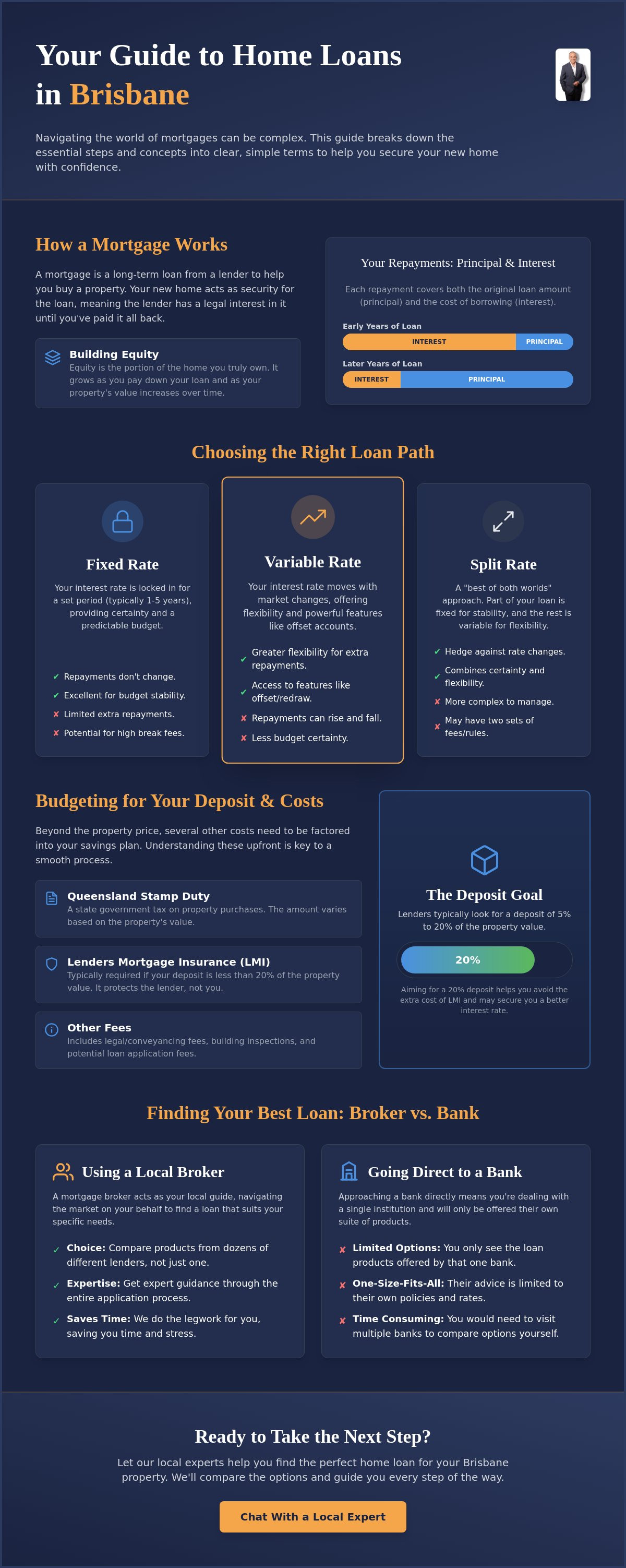
Thinking about buying a home can feel like learning a whole new language. At its heart, a mortgage loan is a long-term deal between you and a lender to help you buy property. The bank gives you the bulk of the money upfront, and in return, the home itself acts as security. This just means if things go south and you can't pay it back, the bank has a legal safety net. To get a deeper look at the history and basics, you can check out this overview of what is a mortgage.
Every time you make a repayment, you're usually paying two different things. There's the principal, which is the actual amount you borrowed. Then there's the interest, which is essentially the fee the bank charges you for using their money. In the early years, a lot of your payment goes toward interest. As time goes on, you start chipping away more at the principal. This builds equity. Think of equity as the portion of the home you truly own outright. It grows as you pay down the loan or if the Brisbane property market sees prices rise.
The Role of the Deposit
Saving for a mortgage loan starts with the deposit. Most lenders in Australia look for a deposit between 5% and 20% of the property's value. If you've saved this money yourself over time, banks call it genuine savings. They love seeing this because it proves you have a good handle on your budget. If your parents are chipping in with a gifted deposit, that's great too, but some banks might still want to see a small slice of your own savings first. A bigger deposit usually means a lower interest rate because the bank sees you as a safer bet. It also helps you avoid extra costs like Lenders Mortgage Insurance, which usually kicks in if your deposit is under 20%.
Mortgage Security and the Banks Rights
When you sign those papers, the bank becomes the mortgagee on your property title. This is their way of saying they have a legal interest in the house until the loan is paid off. If you stop making repayments, the bank has the right to sell the property to get their money back. It sounds scary, but it's a last resort. They also care about what you buy. A standard house in a Brisbane suburb is easy for them to value. A tiny apartment or a remote block of land? That's trickier. This is why banks sometimes say no to specific properties even if your finances are perfect. They want to know the security is easy to sell if they ever need to.
Choosing the Right Path: Fixed, Variable, and Split Rate Loans
Which path is right for you? It's one of the first big decisions you'll make when setting up your mortgage loan. In Australia, we generally have three main ways to structure your repayments. You can lock them in, let them flow with the market, or do a bit of both. There isn't a perfect answer, just the one that helps you sleep better at night. Most people in Brisbane find that their choice depends on whether they value a predictable budget or the freedom to pay off their home faster.
Fixed rate loans give you total certainty. You'll know exactly what's coming out of your bank account every month for a set time, usually between one and five years. This is a lifesaver for families who need to know their expenses down to the cent. On the flip side, variable rate loans move up or down based on the market and the RBA cash rate, which sits at 4.35% as of June 2026. While variable rates can be a bit of a rollercoaster, they often come with more bells and whistles. When you are choosing a home loan, it's worth weighing up that peace of mind against the flexibility to make extra payments whenever you like.
Can't decide? A split loan might be the go. You can put a portion of your loan on a fixed rate to keep things stable and leave the rest variable. It's a popular best of both worlds approach that lets you hedge your bets against future rate changes while still keeping some handy features.
Fixed vs Variable: Which is Right for You?
Locking in a rate in 2026 can feel like a gamble. If rates drop, you're stuck paying the higher amount. If they rise, you're laughing. The real trick is preparing for rate shock. This happens when your low fixed term ends and you suddenly jump to a much higher variable rate. It's a bit like a cold shower after a warm bath. Variable loans are often the pick for those who expect their income to grow or who want to make unlimited extra repayments without being hit by break fees. If you're unsure which way the wind is blowing, it's a great idea to chat with a local expert who can show you how each option looks for your specific budget.
Understanding Offset Accounts and Redraw
Let's talk about the features that actually save you money. An offset account is just a normal transaction account linked to your mortgage loan. If you have $20,000 in there and a $500,000 loan, the bank only charges you interest on $480,000. It's a brilliant way to use your savings to chip away at your debt. Then there's redraw. This allows you to put extra money directly into your loan and take it back out if you ever need it for a rainy day. While they sound similar, an offset account is usually more flexible because it's a separate account you can tap into instantly with a debit card. These features can save you thousands of dollars and years of time if you use them right.
The "Hidden" Costs: Stamp Duty, LMI, and Fees
Buying a home is about more than just the price on the contract. It's easy to get focused on the house itself, but there are a few extra costs that can pop up and surprise you if you aren't ready. These "hidden" costs are a normal part of the process, but they do need to be factored into your budget from day one. When you're calculating how much you need for your mortgage loan, remember to look beyond the deposit.
The biggest extra is usually stamp duty. This is a tax the Queensland government charges on property purchases. The amount depends on the price of the home and whether you plan to live in it or rent it out. If you're a first-timer, you might be eligible for some great savings. For a full breakdown on what's available right now, take a look at our First Home Buyers QLD: Your 2026 Guide to Grants, Loans, and Buying in Brisbane. It covers everything from stamp duty concessions to the latest grants.
Lenders Mortgage Insurance (LMI) Explained
If your deposit is less than 20% of the property value, you'll likely need to pay Lenders Mortgage Insurance (LMI). It's a common point of confusion because even though you pay the premium, it actually protects the bank, not you. If you can't make your repayments and the house is sold for less than what you owe, LMI covers the bank's loss. Lenders Mortgage Insurance (LMI) is a one-off premium that allows you to buy with a smaller deposit. You can often avoid this cost entirely if you have a 20% deposit or if a family member acts as a guarantor for your loan.
Queensland Stamp Duty and Concessions
For those looking to build their own slice of paradise in Brisbane, the First Home Vacant Land Concession can be a huge help. It can significantly reduce the tax you pay on your block of land. Beyond the tax man, you'll also need to budget for legal and conveyancing fees. In South-East Queensland, you should generally set aside between A$1,500 and A$2,500 for a good conveyancer to handle the paperwork and ensure the title transfer goes smoothly. Don't forget about the bank's own fees too. These can include:
- Application or establishment fees for setting up the loan.
- Valuation fees so the bank can check what the property is worth.
- Settlement costs for the final legal transfer of funds.
- Ongoing annual package fees or monthly service charges.
Getting these numbers clear early on means no nasty surprises on settlement day. It's all about making sure your mortgage loan journey is as smooth as possible.
The Road to Approval: How to Organise Your Finances
Getting your mortgage loan approved is a bit like preparing for a big race. You wouldn't just turn up at the starting line without any training. Banks are looking for stability and a clear picture of how you handle your money. It starts with knowing your limit. Assessing your borrowing capacity isn't just about what you think you can afford. Lenders use their own complex calculators to decide how much they're willing to risk based on your income and the new 2026 debt-to-income limits.
Next, it's time for a bit of financial spring cleaning. Banks usually want to see your last three to six months of bank statements. They're looking for consistent savings and a lack of "red flag" spending habits. After that, you'll need to gather your proof of income. This means having your latest payslips, tax returns, and PAYG summaries ready to go. If you're self-employed, you'll likely need at least two years of tax returns to show a steady history of earnings.
Finally, you want that pre-approval. This is essentially a "green light" from the bank, letting you know how much you can spend before you start making offers. In a fast-moving market like Brisbane, this is your best friend at Saturday morning auctions.
What Banks Look for in a Borrower
Lenders often talk about the "Three Cs". Character (your credit history and reliability), Capacity (your ability to pay the loan back), and Collateral (the actual house you're buying). They also look closely at your other debts. Your HECS or HELP debt is a big one. Even though it's a student loan, the repayments reduce your take-home pay, which lowers your borrowing power. Credit card limits are another common trap. Banks look at the total limit, not just what you owe. Even if you don't use the card, a A$10,000 limit is seen as a potential A$10,000 debt. Buy Now, Pay Later services can also be a hurdle. Many lenders see these as ongoing financial commitments that eat into your monthly budget.
The Importance of Pre-Approval
A pre-approval usually lasts for about 90 days, giving you three months to find the right spot. It's important to know the difference between a "system-generated" one and a "fully assessed" one. A system-generated letter is often just a quick computer check of your numbers. A fully assessed pre-approval means a real person has looked at your documents and given a much firmer "yes". Having this in your pocket is essential for the competitive Brisbane property market. It shows agents you're a serious buyer and lets you bid with confidence. Ready to see where you stand? You can get started on your pre-approval today with a quick chat about your goals.
Broker vs. Bank: Finding the Best Mortgage Loan for You
When you're ready to make your move, you have a big choice to make. Do you walk into your local branch, or do you chat with a broker? It might feel easier to stick with the bank you've been with since you were a kid. But here is the catch. A bank can only sell you their own products. It's a bit like going to a shoe store that only sells one brand. They might have a pair that fits, but you'll never know if there was a better, more comfortable option just down the road.
A mortgage broker works differently. We act as your personal shopper for a mortgage loan. Instead of one set of options, we compare products from over 60 different lenders. This is especially helpful if your situation isn't perfectly "cookie-cutter". Maybe you're self-employed, or perhaps you're working with a smaller deposit. Whatever the case, a broker's job is to find the lender that says "yes" when others might say "no".
The best part for most Australians? This service usually doesn't cost you a cent. Brokers are typically paid by the lender once your loan settles. You get all the expert research, the comparison work, and the application management without an extra bill. It's a win-win that takes the heavy lifting off your shoulders so you can focus on the exciting part, like picking out new furniture.
Why a Local Brisbane Broker Wins
Brisbane isn't just a map to us; it's home. We know the difference between a character-filled Queenslander in Paddington and a modern high-rise apartment in Chermside. Every suburb has its own quirks, and different lenders have different rules about what they will and won't fund in specific postcodes. We use that local knowledge to make sure your mortgage loan application doesn't hit any unexpected snags. It's about knowing the local streets as well as the local spreadsheets.
You also get a personal connection. You won't be stuck on hold with a call centre in a different time zone. You'll be talking directly to Andrew. We handle the mountain of paperwork from the first form through to the day you get your keys. Having a real person in your corner who knows your name and your story makes the whole process feel much less like a transaction and more like a partnership.
How to Get Started Today
The first step is often the hardest, but it doesn't have to be. We start with a simple, no-obligation chat to see where you're at. There is absolutely no judgment here. Whether you have a massive deposit ready to go or you're just starting to save your first few dollars, everyone has to start somewhere. We'll look at your goals and give you a clear, honest picture of your options. Ready to see what you can borrow? Get in touch with Andrew for a free consultation.
Ready to Turn Your Home Ownership Goals Into a Reality?
Navigating the Brisbane property market shouldn't feel like a high-stress exam. You've now got the tools to understand how a mortgage loan works, from avoiding jargon-heavy traps to choosing the right repayment path. Whether it's clearing up the mystery of LMI or getting your bank statements ready for a lender's eyes, you're already ahead of the pack. Knowledge is the best way to lower that barrier to entry.
You don't have to do the heavy lifting alone. I provide access to over 60 lenders and use my local Brisbane market expertise to find the right fit for your unique life. My service is at zero cost to you as the borrower. I'm here to make the process feel straightforward and supportive, every step of the way. Ready to get some clear answers? Book a free, no-obligation home loan strategy session with Andrew today. Let's make your next move a confident one.
Frequently Asked Questions
Is it better to get a mortgage through a bank or a broker?
A broker is almost always the better choice because they compare over 60 lenders for you, while a bank only offers its own products. This gives you a much wider range of options and a better chance of finding a deal that actually fits your life. Best of all, brokers in Australia generally provide this service at no cost to you. It's like having a personal shopper who knows all the secret sales.
How much deposit do I really need for a home loan in Brisbane?
You generally need at least 5% of the property value, though 20% is the ideal amount to avoid paying for Lenders Mortgage Insurance. As of June 2026, the Australian Government's 5% Deposit Scheme allows eligible buyers to purchase a home with just a 5% deposit without that extra insurance cost. For an existing home in Queensland, you might also get a stamp duty exemption if the price is under A$700,000.
Can I get a mortgage loan if I am self-employed?
Yes, you can absolutely secure a mortgage loan while working for yourself. Most lenders will ask to see your tax returns and financial statements for the last two years to make sure your income is steady. Some specialist lenders offer different ways to prove your earnings if you don't have every single document ready. It's all about showing the bank that you have a consistent track record of earning money.
What is the First Home Owners Grant and do I qualify in 2026?
The First Home Owner Grant is a one-off government payment designed to help you buy or build a brand-new home. In Queensland, as of June 2026, the grant is A$30,000 for eligible new builds if you sign your contract before 30 June 2026. To qualify, you must be an Australian citizen or permanent resident, and the property must be your very first home. It's a fantastic boost for your total deposit.
How much can I borrow based on my salary?
Most banks will now limit your borrowing to about six times your gross annual income due to debt-to-income rules introduced in early 2026. For example, if your household earns A$150,000 a year, your total debt would typically be capped at A$900,000. Lenders also perform a "stress test" to ensure you can still afford the repayments if interest rates were to rise by another 3% above your current offer.
Does a credit card limit affect my home loan application?
Yes, your total credit card limit has a big impact on your borrowing power, even if you never use the card. Banks view a A$10,000 limit as a potential A$10,000 debt that you could spend tomorrow. Lowering your limits or closing unused accounts before you apply for a mortgage loan is one of the easiest ways to increase the amount a bank is willing to lend you.
What happens if interest rates go up after I get my loan?
If you have a variable rate loan, your monthly repayments will increase whenever the bank raises its rates. With the average variable rate sitting at 6.95% in June 2026, many borrowers choose to fix a portion of their loan for certainty. If you're on a fixed rate, your payments stay exactly the same until the fixed term ends. It's always smart to build a small buffer into your budget for future changes.
How long does the mortgage approval process usually take?
A standard approval usually takes between two to four weeks once you've submitted all your paperwork. Getting a pre-approval can sometimes be quicker, but a full "unconditional" approval requires a human credit officer to check your documents and the bank to value the property. Having your payslips, tax returns, and bank statements organised and ready to go from day one is the best way to avoid any annoying delays.


