

Did you know that being a "loyal" customer might be costing you thousands of dollars every single year? It sounds backwards, but when you compare home loan rates Brisbane banks are offering right now, you often find that new customers get the red carpet while long-term locals get stuck with a "loyalty tax."
We get it. With the cost of living in South-East Queensland climbing and the average variable rate sitting around 6.92 per cent in July 2026, the last thing you need is a mortgage that feels like a heavy weight. It's completely normal to feel a bit overwhelmed by jargon like LVR or to worry that you're missing out on a better deal. This guide is here to take that pressure off. You'll learn how to navigate the 2026 property market with confidence, cut through the banking noise, and find a loan that actually fits your life.
We're going to break down the latest interest rate trends, explain those tricky features in plain English, and show you exactly how to secure lower monthly repayments without the usual stress. Let's get started.
Key Takeaways
- See why Brisbane's unique 2026 market means your old bank might not be giving you the best deal anymore.
- Get a plain-English breakdown of variable and fixed rates so you can decide what actually suits your family's budget.
- Learn how to use the comparison rate to compare home loan rates Brisbane banks offer without getting tripped up by confusing jargon or LVR rules.
- Use the "Three-Lender Rule" to audit your mortgage and see if you’re paying more than you should.
- Discover the secret to finding "unlisted" rates that search engines and big bank websites often keep hidden.
Why Comparing Home Loan Rates in Brisbane Matters in 2026
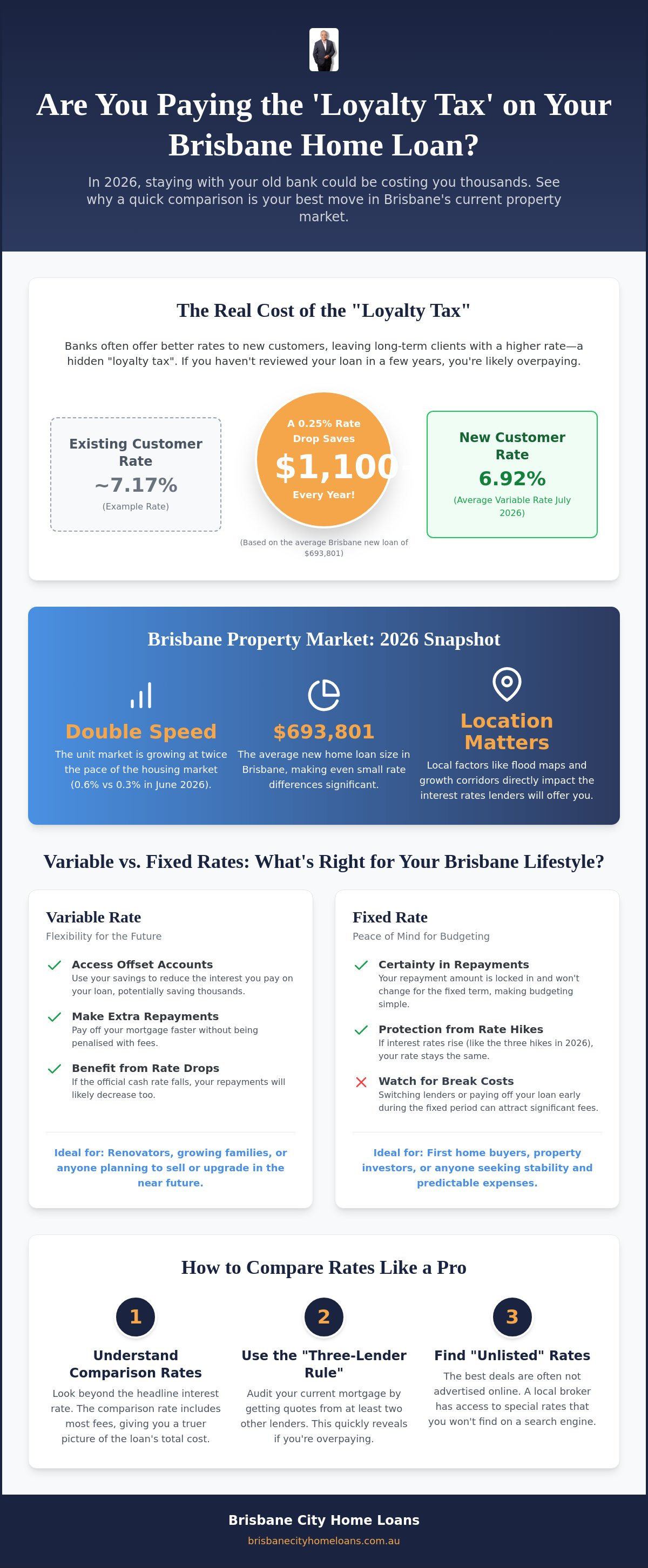
Thinking about your mortgage shouldn't feel like a chore. For most of us in Brisbane, it's just part of life. But here's the thing. When you take a moment to compare home loan rates Brisbane lenders are offering, you're doing more than just chasing a lower number. You're making sure your money stays in your pocket rather than the bank's vault. In 2026, the "set and forget" mindset is a recipe for overpaying. With the average new home loan now sitting at $693,801, even a tiny 0.25 per cent difference in your rate can save you over $1,100 a year in interest. Over a 30-year term, that’s tens of thousands of dollars you could be spending on your family instead.
Before we dive into the nitty-gritty, it helps to be clear on the basics of what a mortgage is and how it serves as a tool for your future. Comparing rates isn't just about the headline figure you see on a billboard. It’s about looking at the total cost of the loan, including fees and features, to see how it fits your specific Brisbane lifestyle. Are you planning to renovate a Queenslander in Coorparoo? Or are you looking for a low-maintenance unit in Chermside? Your goals change which loan is actually "best" for you.
The Brisbane Property Landscape in 2026
Brisbane is a unique beast right now. While the housing market grew by 0.3 per cent in June 2026, the unit market is actually growing at double that speed. This shift means lenders are changing how they look at different types of properties. If you're buying in high-demand growth corridors, you might find lenders are more eager to win your business with sharper rates. However, we also have to talk about local factors like flood maps. In Brisbane, your property’s location can impact your loan approval and the rates you're offered. Lenders look at risk differently in 2026, so having a local perspective on South-East Queensland growth is essential for getting a fair deal.
The Real Cost of the "Loyalty Tax"
Have you ever noticed that new customers always seem to get the better deals? It’s frustrating, but it’s how many big banks operate. They rely on the fact that most people are too busy to compare home loan rates Brisbane and switch. This is what we call the "loyalty tax." If you've been with the same lender for more than a few years, there’s a high chance you’re paying a premium just for staying put. Identifying this is simple; just look at the rate your bank is offering to new borrowers today. If yours is higher, you're paying the tax. Regular reviews are the only way to make sure you aren't subsidising someone else's discounted rate.
Variable vs. Fixed Rates: Which Suits Your Brisbane Lifestyle?
Is it better to have a mortgage that moves with the market or one that stays exactly the same? It's a question we hear all the time. Choosing between a fixed or variable rate isn't just a financial choice; it's a lifestyle one. Do you want the freedom to pay off your house faster, or do you need the comfort of knowing exactly what's coming out of your bank account every fortnight? When you compare home loan rates Brisbane lenders are currently advertising, you'll find that the right answer usually depends on your plans for the next few years.
Variable Rates: Flexibility for the Future
Variable rates are the ultimate "go with the flow" option. They give you access to helpful tools like offset accounts, which can save you a massive amount of interest just by keeping your savings in the right place. You can also make extra repayments whenever you have a bit of spare cash without the bank charging you a fee for being proactive. This flexibility is perfect if you're thinking about unlocking home equity to fund a renovation or if you're planning to sell and move to a bigger place as the family grows. Since the average variable rate in July 2026 is around 6.92 per cent, staying variable means you can also benefit immediately if rates start to dip.
Fixed Rates: Peace of Mind for Budgeting
On the other hand, fixed rates act like a security blanket. With three interest rate hikes already recorded in 2026, many families are looking for a bit of stability. If you lock in your rate, your repayments won't budge, no matter what the Reserve Bank does. This is often a winner for first-home buyers who are still getting used to a new budget. Just be mindful that fixed loans can be a bit rigid. If you want to switch lenders to avoid that "loyalty tax" we mentioned earlier, you might face break costs. Learning how to compare home loans involves weighing up that immediate peace of mind against the potential cost of being "locked in" for a set term.
Many of our clients find that a "split loan" is the best way to have their cake and eat it too. You can fix a portion of your debt to protect yourself against future hikes while keeping the rest variable so you can still use an offset account. It's a smart way to compare home loan rates Brisbane banks offer and create a package that actually works for your specific situation. If you're feeling a bit unsure about which path to take, you can always reach out for a friendly chat to see what makes sense for your goals.
Decoding Comparison Rates and LVR: Plain English for Homeowners
Let’s be honest. Most of us glaze over when we hear bank acronyms. But if you want to compare home loan rates Brisbane lenders are showing off, you need to know which numbers actually matter. There are two big ones that decide how much you pay: the comparison rate and your LVR. Think of them as the "true price" and the "risk score" for your loan. Understanding these doesn't just make you a smarter borrower; it gives you the confidence to tell a good deal from a dud.
What is a Comparison Rate, Really?
You’ve seen the ads. A tiny interest rate in big, bold numbers. That’s the headline rate. But look closer and you’ll see a second, slightly higher number. That’s your comparison rate. It’s the law for banks to show this because it includes the interest plus most of the fees and charges you’ll pay. A low headline rate is a trap if the comparison rate is significantly higher because it means the bank is hiding expensive monthly fees or setup costs in the fine print. To see how to compare home loans effectively, always look at that comparison rate first. It’s the only way to compare apples with apples and see what is actually coming out of your pocket every month.
Understanding LVR in the Brisbane Market
LVR stands for Loan-to-Value Ratio. In plain English? It’s the percentage of the property’s price that you’re borrowing. If you’re buying a $700,000 house in Chermside and you have a $140,000 deposit, your LVR is 80 per cent. This is the magic number for most Brisbane lenders. If you borrow more than 80 per cent, you usually have to pay Lenders Mortgage Insurance (LMI), which can add thousands to your overall costs. You can check out our First Home Buyers QLD guide to see how this fits with local grants and deposit requirements for 2026.
Here is the good news for locals. Because Brisbane property values rose by 0.3 per cent in June 2026, your LVR might be improving without you even trying. As your home becomes worth more, the portion the bank owns gets smaller compared to your equity. This is a huge win when you go to compare home loan rates Brisbane banks offer for refinancing. A lower LVR often unlocks much sharper rates because the bank sees you as a lower-risk borrower. You don't always need more cash in the bank to get a better deal; sometimes, you just need a bit of time and a healthy local market. If you haven't checked your property's value lately, you might be surprised at how much bargaining power you've gained.
How to Compare Home Loan Rates Like a Pro
Ready to roll up your sleeves? You don't need a degree in finance to work out if you're getting a raw deal. Most people avoid this because they think it'll take all weekend. In reality, you can get a pretty clear picture in about thirty minutes. When you sit down to compare home loan rates Brisbane lenders are currently offering, the goal isn't just to find the lowest number. It's about finding the best value for your specific life. Don't worry about being an expert; you just need to be curious.
Gather Your Current Loan Data
First things first, you need to know your starting line. Dig out your latest mortgage statement or log into your banking app. You’re looking for your current interest rate and any annual fees you're paying. Check if you’re still in a fixed period or if you’ve rolled onto a standard variable rate. If you’re on a "honeymoon" rate that’s about to expire, your repayments could be about to jump. Organising this paperwork now makes the rest of the process feel a lot more manageable and less like guesswork.
Evaluate the "Must-Have" Features
A low rate is great, but it shouldn't come at the cost of the features you actually use. Ask yourself:
- Do I need a 100% offset account to lower my interest?
- Will I want to make extra repayments without being penalised?
- Is there a "package fee" of $395 or more that wipes out the savings from a slightly lower rate?
To really compare home loan rates Brisbane like an expert, try the "Three-Lender Rule." Look at one big four bank, one online-only lender, and one customer-owned bank or credit union. This gives you a diverse sample size and a better feel for the market. Also, take a quick peek at your credit score. A clean score often unlocks "tier one" rates that aren't available to everyone. If you're feeling stuck or just want a second pair of eyes to check your work, you can book a quick rate review with us to see how your current deal stacks up against the rest of the market.
Why a Local Brisbane Broker Beats an Online Search
Online comparison sites are handy for a quick browse, but they have one big flaw: they don't actually know you. They don't know if you're self-employed, if you've just started a new job in Fortitude Valley, or if your property has unique quirks. When you're trying to compare home loan rates Brisbane lenders have on offer, a generic search engine will only show you the products that fit their pre-set boxes. It's the "computer says no" syndrome, and it can be incredibly frustrating when you know you're a solid borrower.
At Brisbane City Home Loans, we see ourselves as your local guide for South-East Queensland. We aren't a faceless institution; we're real people who live and work in the same community as you. Because we're independent, our only goal is finding the loan that actually fits your life. Since 76 per cent of Australians now use a mortgage broker, it's clear that most homeowners value having an expert advocate in their corner rather than just a digital list.
Personalised Guidance vs. Automated Results
This is where having a human expert like Andrew changes everything. Unlike an algorithm, Andrew listens to your story. If your situation is a bit "outside the box"—perhaps you're casual, a freelancer, or using a guarantor—he knows which lenders are more likely to be welcoming. He also takes the "admin headache" off your plate. Instead of you chasing three different banks for updates, Andrew manages the entire application process from your first inquiry all the way to settlement. You get a single point of contact who actually understands your goals.
One of the best-kept secrets in the industry is that brokers often have access to "unlisted" rates. These are special offers or discretionary discounts that banks don't put on their public websites or comparison tools. Best of all, this is a no-cost service for you. The lender pays the commission once the loan is settled, so you get professional advice and a local guide without adding another expense to your household budget.
Ready to Find a Better Rate?
Navigating the 2026 market doesn't have to be a solo mission. Whether you're looking for your first home loan, ready to refinance, or looking at investment loans, we're here to make the process feel light and manageable. You don't need to be a finance expert to get a great deal; you just need a guide who knows the Brisbane streets and the banking systems inside out. A free, no-obligation consultation is all it takes to see if there's a sharper, more comfortable fit for your life out there.
Contact Andrew for a free Brisbane rate comparison today and let's see how much we can save you.
Ready to Make Your Move?
You now have the tools to look at your home loan with fresh eyes. The 2026 market moves fast, but you don't need to be a finance expert to keep up. Whether you decide to fix your rate for that extra bit of certainty or keep things variable for the flexibility of an offset account, the most important thing is that your loan works for your specific Brisbane lifestyle. Don't let the loyalty tax eat into your budget when there are so many options available.
Now is the perfect time to compare home loan rates Brisbane wide and see if you could be saving more each month. Andrew has been sharing his local Brisbane expertise since 2022, helping families across the city find better deals from a panel of over 60 lenders. Because it’s a zero-cost service for you, you can get professional guidance without any of the usual stress or financial pressure.
Ready to see if you could be doing better? You can book a free rate review with Andrew at Brisbane City Home Loans today. Let's get your mortgage sorted so you can get back to enjoying life in the Sunshine State. You've got this!
Frequently Asked Questions
How often should I compare home loan rates in Brisbane?
You should aim to compare your mortgage every 12 to 18 months. Banks are constantly launching new deals to attract fresh customers, meaning long-term locals often end up on higher rates. If you haven't checked your rate since early 2025, you might be surprised by how much the market has moved. A quick annual review is the best way to keep your bank honest and your repayments as low as possible.
Is the lowest interest rate always the best home loan?
No, the lowest interest rate isn't always the best choice for every family. You have to look at the comparison rate and the features included to see the full picture. A loan with a rock-bottom rate might have a high annual fee or lack an offset account, which could cost you more in the long run. It is about finding a balance between a sharp rate and the tools that help you pay off your house faster.
Can I compare home loan rates if I have a small deposit?
Yes, you can definitely compare home loan rates Brisbane lenders offer even if your deposit is on the smaller side. While an 80 per cent LVR usually unlocks the lowest rates, many banks have competitive options for 5 or 10 per cent deposits. You might need to factor in Lenders Mortgage Insurance, but comparing different lenders helps you find the one with the most affordable entry costs for your specific situation.
What is the RBA cash rate and how does it affect my Brisbane mortgage?
The RBA cash rate is the official interest rate set by the Reserve Bank of Australia. It acts as a benchmark for the rest of the economy. When the RBA raises this rate, as we have seen three times already in 2026, banks usually pass that increase on to your variable mortgage repayments. Understanding this connection helps you decide if you should stick with a variable rate or lock in a fixed term for more certainty.
Do I have to pay a fee to use a Brisbane mortgage broker for comparison?
No, you generally won't have to pay a fee to use a broker for a mortgage comparison. Most brokers are paid a commission by the lender once your new loan is settled. This means you get access to local expertise and over 60 different lenders without any out-of-pocket costs. It is a great way to get a professional opinion on your current deal without any financial pressure or obligation to switch.
How long does it take to switch home loans if I find a better rate?
It typically takes between four to six weeks to fully switch your home loan. While the initial comparison and application can be done quite quickly, the banks need time to organise property valuations and discharge your old mortgage. Your broker does most of the legwork, so you don't have to worry about the admin. It is a straightforward process that can save you thousands of dollars in interest over the life of your loan.
What documents do I need to compare home loan rates effectively?
To start, all you really need is your most recent mortgage statement and a basic idea of your income. This statement shows your current rate, balance, and any fees you are paying, which is essential to compare home loan rates Brisbane banks are offering right now. If you decide to go ahead with a new loan, you will eventually need things like payslips and bank statements, but a single statement is enough for an initial check.
Can I compare rates for an investment property the same way as a home loan?
Yes, you compare them in a very similar way, though you should expect investment rates to be slightly higher than owner-occupied ones. Lenders view investment loans as a different type of risk. When you are looking at investment options, you will also want to focus on features like interest-only periods or offset accounts to help with your tax strategy. The goal is always to find a rate that keeps your investment profitable and manageable.


