

What if I told you that a generic bank calculator might be underestimating your actual borrowing power by $100,000 or more? It is a common frustration for many Brisbane buyers. You spend an evening playing with a home loan serviceability calculator QLD tool, only to find that every bank gives you a completely different number. It is confusing, and honestly, a bit stressful when you are trying to plan your future.
I get it. Between the RBA holding the cash rate at 4.35% and those 3% "stress tests" the banks use, the goalposts feel like they are constantly moving. You are probably wondering which expenses actually count and why one lender is so much stricter than the next. This article is here to clear the air. I will show you how Queensland lenders really calculate your borrowing capacity and how you can clean up your finances to get a better result.
We will look at the specific rules for 2026, from local stamp duty concessions to finding lenders with a higher appetite for risk. By the end, you will have a realistic view of what you can afford and a clear plan to boost your approval chances.
Key Takeaways
- Understand that serviceability is a lender's way of checking if you can comfortably afford repayments if interest rates rise or life gets more expensive.
- Learn why a home loan serviceability calculator QLD often produces conflicting results and how to find the lender that views your income most favourably.
- Discover the "hidden" benchmarks banks use to estimate your living costs and why your actual spending habits might not be the only thing they look at.
- Identify quick ways to "clean up" your finances, such as reducing credit card limits or closing "Buy Now, Pay Later" accounts to immediately improve your borrowing capacity.
- See how a local Brisbane expert can help you move beyond generic algorithms to build a strategy that targets the right lender for your specific goals.
What is Home Loan Serviceability and Why Does it Matter in QLD?
Serviceability is a bit of a fancy word for a very simple question. When you ask for a loan, the bank is really just asking: "Can you actually pay us back if life gets expensive?" It is not a judgment on your character or how hard you work. Instead, it is a mathematical formula. Lenders take what they call your "shaded" income and weigh it against your monthly expenses. In our current 2026 market, this calculation is the most important hurdle you will face before you can start picking out paint colours for a new place in Coorparoo or North Lakes.
Most people start their journey by playing around with a home loan serviceability calculator QLD tool. These are great for getting a "ballpark" figure, but they don't always show the full picture. Banks are naturally cautious. They want to be 100% sure that you won't struggle if things change. Understanding how they arrive at their final number is the first step toward a successful Brisbane property purchase. It helps you see your finances through the bank's eyes, which is often very different from how we see our own bank statements.
The 3% Serviceability Buffer Explained
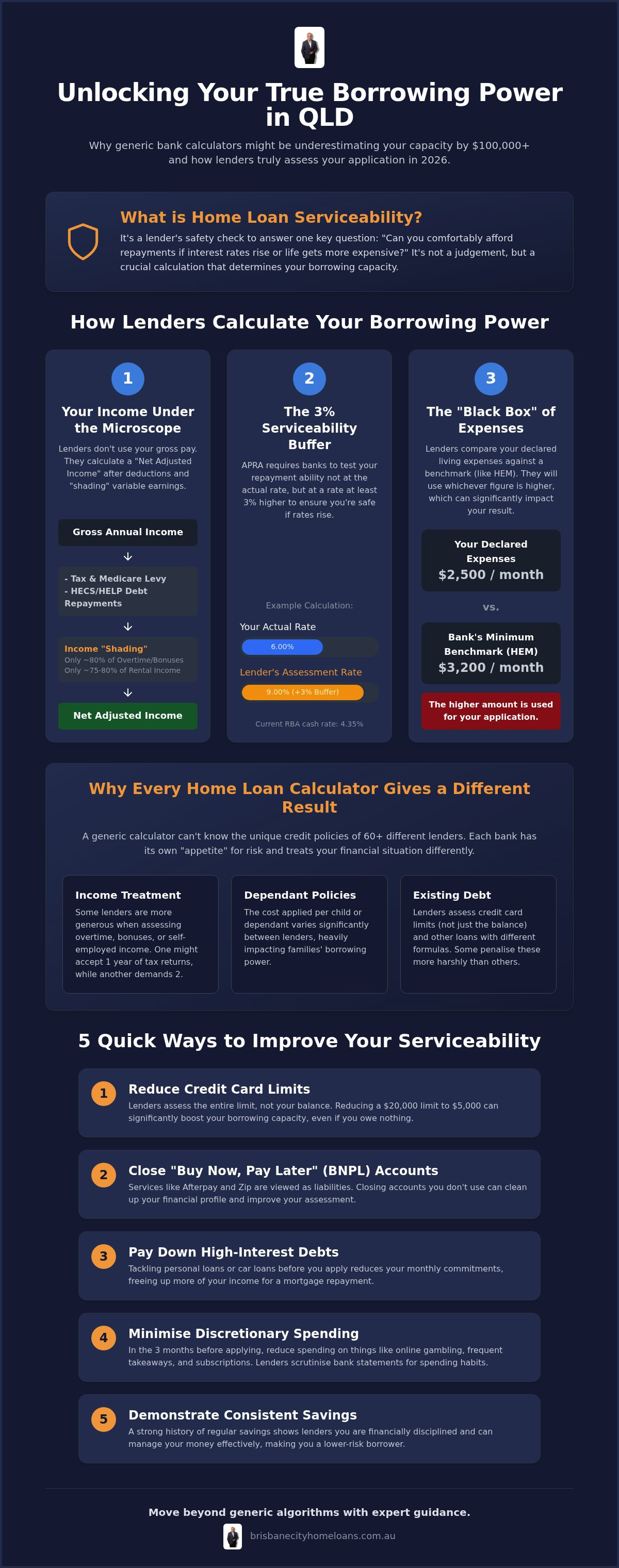
Lenders don't just look at the interest rate you see on the billboard. Even with the RBA cash rate currently at 4.35%, banks apply a "stress test" to every application. This is a 3% safety margin. If your actual interest rate is 6%, the bank calculates your ability to pay as if the rate were 9%. The APRA serviceability buffer acts as a safety net for 2026 to ensure you can still afford your home if rates climb higher in the future. It might feel a bit strict, but it is there to protect you from getting into a tight spot later on. It is about making sure your dream home doesn't become a source of stress.
Net Adjusted Income: What the Bank Actually Sees
Your "take-home pay" and what the bank calls "disposable income" are often two different things. Before the calculation even starts, the bank peels away layers of your income. They subtract tax, the Medicare levy, and any HECS or HELP debts you might be carrying. What is left is your "net adjusted income." This is your true "bank-ready" salary. Many buyers find that Flexible Mortgage Options like offset accounts can help manage this net position better over time, but the initial test is always conservative.
Banks also "shade" certain types of earnings. If you rely on overtime, bonuses, or rental income, a lender might only count 80% of that money. They do this because those income streams can be unpredictable. They want to know that even if the overtime dries up, the mortgage still gets paid. This is exactly why a home loan serviceability calculator QLD might give you a different result than a real-life lender. Every bank has a slightly different way of "shading" your hard-earned cash.
Why Every Home Loan Serviceability Calculator QLD Gives a Different Result
Ever spent an evening clicking through different bank websites only to end up more confused than when you started? It is a common story. You use one home loan serviceability calculator QLD and it gives you a green light for $700,000. You try another, and suddenly you are only "eligible" for $550,000. Why the massive gap? It comes down to "appetite." Banks are like people; they all have different preferences. Some lenders are very generous with families who have several dependants. Others are much more conservative and prefer single professionals with very predictable salaries.
A generic tool simply cannot keep up with the 60+ different credit policies floating around the Australian market. This is exactly why Andrew looks beyond the surface. He knows which lenders are currently "hungry" for your specific type of application and which ones are likely to knock you back based on their current internal rules.
How Lenders Treat Different Income Types
Income isn't just a single number to a bank. If you earn a base salary plus overtime or regular bonuses, some lenders will only count 80% of those extras. They "shade" it just in case that overtime disappears next month. It is a similar story for rental income. Most banks only count about 75% to 80% of what your tenant pays you to cover potential vacancies or repairs. For the self-employed, things get even more varied. One bank might look at your last two years of tax returns, while another might only need the most recent year. It is why Moneysmart's Guide to Home Loans is such a handy starting point for understanding the basics of how these rules work across the board.
The "Non-Standard" Borrower Advantage
Are you a contractor or a casual worker? If so, a big bank's home loan serviceability calculator QLD might spit out a very low number. But that does not mean you cannot get a loan. Some lenders specialise in these "non-standard" situations. We also see special policies for essential workers or medical professionals in the Brisbane area. Some banks offer higher borrowing limits or waived fees for nurses, teachers, and doctors because they view these roles as exceptionally stable. Matching your specific job and life situation to the right lender policy is often the "secret sauce" to getting an approval.
This is where having a local guide makes all the difference. Andrew compares over 60 different lenders to find the one whose policy fits your life, not the other way around. If you want to see how your specific situation stacks up against different bank rules, you can get a clearer picture of your options here. We don't just give you a generic number; we find the lender that is most likely to say "yes" to your specific story.
The HEM and Your Expenses: The "Black Box" of Borrowing Power
When you sit down to use a home loan serviceability calculator QLD, you will usually see a little box asking for your monthly living expenses. It seems simple enough. You might look at your grocery bills, your Netflix subscription, and your gym membership and come up with a number. But there is a secret yardstick banks use behind the scenes that can catch you off guard. It is called the Household Expenditure Measure, or HEM for short. Think of it as the bank's "reality check" for your lifestyle.
Lenders are required to be responsible. They want to make sure you aren't overstretching yourself. If you tell a bank that you live on "two-minute noodles" and spend almost nothing each month, they probably won't believe you. Even if you are a champion at saving, the bank will compare your stated costs against the HEM. They will always use whichever number is higher. If you say you spend $2,000 a month but the benchmark says a family of your size in Brisbane needs $3,000, the bank will use the $3,000 figure. It is their way of ensuring you have enough "breathing room" for the basics.
What is the Household Expenditure Measure (HEM)?
The HEM is a benchmark calculated using data from the Australian Bureau of Statistics. It looks at your location, how many children or dependants you have, and your general lifestyle level. It covers the absolute essentials like food, clothing, and utilities, but also includes some "non-essential" but common costs. In 2026, banks are looking closer than ever at these figures to ensure borrowers aren't hit too hard by rising costs. The HEM is a "floor" for expenses, not a ceiling, which means the bank will never assume you spend less than this baseline.
QLD Specific Costs: Body Corporate and Rates
In South East Queensland, we have some unique costs that can swallow up your borrowing power if you aren't careful. If you are eyeing a trendy unit in West End or a townhouse in Chermside, you have to account for body corporate fees. These aren't just a minor detail; lenders subtract these fees directly from your income before they even start the serviceability calculation. High fees can significantly reduce how much you can borrow.
- Council Rates: Brisbane City Council and surrounding regional rates are a fixed cost that banks factor into your ongoing "holding costs."
- Insurance: With Queensland's weather history, home and contents insurance can be higher here than in other states. Lenders will look at these premiums as a mandatory expense.
- Lifestyle Creep: Do you have multiple streaming services, high-end private school fees, or regular dining out habits? Your bank statements will tell the story, and lenders will check if your actual spending is significantly higher than the HEM benchmark.
This is a detail that a basic home loan serviceability calculator QLD often skips over. It might tell you that you can afford a certain loan amount, but it doesn't know you are looking at a complex with a pool, a lift, and high strata levies. We take the time to look at the specific property type you want to buy so we can give you a much more accurate estimate of your true borrowing limit.
5 Ways to Improve Your Serviceability Before Applying
If you've spent any time on a home loan serviceability calculator QLD, you might feel a bit stuck with the result. But here is the good news: that number is not final. You actually have a lot of control over how the bank sees you. Think of your loan application like a first date. You want to show up looking your absolute best, with no hidden surprises. By taking a few simple steps in the months before you apply, you can often push your borrowing power much higher than a generic tool suggests.
Here are five practical ways to boost your chances of a "yes":
- Trim your credit card limits: Banks don't care if you pay your balance off every month. They look at the total limit as a potential debt you could run up tomorrow.
- Ditch the "Buy Now, Pay Later" accounts: Close your Afterpay, Zip, or Klarna accounts. Even if they are sitting at zero, lenders treat these as ongoing credit commitments that eat into your monthly budget.
- Consolidate your debts: If you have a small car loan and a couple of personal loans, consider rolling them into one. Lowering your total monthly repayments is a huge win for serviceability.
- Audit your "fun" spending: For three months, try to keep the Uber Eats and luxury subscriptions to a minimum. It shows the bank you have the discipline to manage a mortgage.
- Get a second opinion: Don't rely on just one bank. Andrew can show you which of our 60+ lenders have the most favourable rules for your specific income type.
The "Credit Card Trap" for Brisbane Buyers
It is one of the most common mistakes we see. You might have a card with a $10,000 limit that you only use for emergencies. To you, it's a safety net. To the bank, it is a liability. Most lenders will assume a monthly repayment of around 3% of that limit, regardless of what you actually owe. This means a $10,000 credit card limit can reduce your borrowing power by $30,000 or more. If you don't need the high limit, drop it to $1,000 or $2,000 before you start using a home loan serviceability calculator QLD for your final figures.
Cleaning Up Your Bank Statements
The three months leading up to your application are your "audition" period. Credit assessors will go through your statements with a fine-tooth comb. They are looking for "red flags" like gambling transactions, late payment fees, or frequent overdrawn notices. These suggest you might struggle with the responsibility of a home loan. If you want a personalised plan to polish your application, Andrew can help you get your finances bank-ready before you ever talk to a lender. We will look at your spending through the eyes of a credit assessor to make sure there are no nasty surprises.
Beyond the Calculator: Why Andrew Makes the Difference
Let's be honest. A home loan serviceability calculator QLD is a cold, hard algorithm. It doesn't know that you are up for a promotion next month or that your "dining out" splurge last month was just a one-off birthday celebration. It just sees numbers on a screen. Andrew is different. As a local Brisbane expert, he looks for the strategic wins and policy "loopholes" that a machine simply misses. He doesn't just give you a generic number; he builds a personal strategy to get you to that "Yes."
Having access to over 60 different lenders is a massive advantage for you. Instead of you trying to squeeze your life into a bank's rigid box, Andrew finds the lender that actually fits your world. Whether you are looking for first home loans, investment loans, or you're ready for your next home, the goal is to find the path of least resistance. Best of all? This service doesn't cost you a cent. We are paid by the lenders, but our loyalty stays firmly with you. We work for your best interest, every single time.
Personalised Guidance for Brisbane Locals
Navigating a complex application can feel like a maze. If you are self-employed, a contractor, or someone with a unique income structure, a standard online tool will likely let you down. Andrew handles the heavy lifting, acting as your single point of contact from your first inquiry right through to settlement. You won't be bounced around a call centre or left waiting for an automated email. If you are just starting out, our First Home Buyers QLD Guide is a great place to see how grants and loans work together in our local 2026 market.
Your Next Steps to a Successful Loan
Don't leave your Brisbane property goals to chance by relying on a generic website. While a home loan serviceability calculator QLD can give you a rough ballpark, a professional assessment is the only way to know your real borrowing power. It is about more than just income and expenses; it is about finding the right policy match. Whether you are buying for the first time or looking at how a Home Loan Refinance Calculator Brisbane might help you save on your current mortgage, the right advice changes everything.
Ready to see what is actually possible? Book a no-obligation chat with Andrew today. We will sit down, look at your numbers without any judgment, and find a lender that sees your potential. It is time to move past the generic guesses and get a clear, confident plan for your future.
Ready to Turn Your Brisbane Property Dream into Reality?
We have covered a lot of ground, from the way banks "shade" your overtime to the hidden benchmarks like the HEM that can impact your results. By now, you should have a much better idea of how to tidy up your finances and why your result on a generic home loan serviceability calculator QLD might not be the final word. Every lender has a different appetite for risk; finding the one that likes your specific situation is the key to a "yes."
You don't have to figure this out alone. Andrew provides a 100% free service for borrowers, comparing over 60 lenders to find the most generous and suitable options for your needs. You get genuine, local Brisbane expertise and the peace of mind that comes from having a real person in your corner. If you are ready to move past the generic estimates and get a clear plan, find out your real borrowing power and chat with Andrew today. Your future home is waiting, and we are here to help you get the keys with confidence.
Frequently Asked Questions
How much can I borrow for a home loan in QLD based on my salary?
You can typically borrow between four and six times your annual gross salary, though this is just a starting point. Lenders then subtract your tax, existing debts, and living costs to see what is left for mortgage repayments. It is why a home loan serviceability calculator QLD is a helpful first step, but it cannot replace a deep dive into your specific financial situation. Every bank has a different way of looking at your income, so the final number can vary significantly between lenders.
Does HECS/HELP debt affect my home loan serviceability in 2026?
Your HECS or HELP debt absolutely impacts your borrowing power because it reduces your monthly take-home pay. Banks don't look at the total balance of the debt as much as they look at the compulsory repayment amount. If you have a large salary, those repayments can be quite high. This means the bank sees less "disposable" income available to cover a new home loan, which naturally brings down your maximum borrowing limit.
What is the current serviceability buffer for Australian banks?
The current serviceability buffer set by APRA is 3%. This means if your actual interest rate is 6%, the bank will test your ability to pay at 9%. This safety margin is designed to protect you from future rate hikes. It is a standard rule across most Australian lenders in 2026, though some smaller lenders might have slightly different internal appetites for risk depending on your deposit size and overall financial health.
Can I include my car loan in the serviceability calculator?
You definitely need to include your car loan repayments when using any calculator. Banks treat car loans as a fixed monthly commitment that directly reduces the amount of money you have left for a mortgage. Even a small monthly payment can have a surprisingly large impact on your total borrowing capacity. If you are close to paying it off, it might be worth doing so before you apply to give your borrowing power a boost.
How do banks calculate living expenses for Brisbane residents?
Lenders use the Household Expenditure Measure (HEM) as a baseline for Brisbane residents, but they also look at your actual bank statements. They will take whichever figure is higher. If your lifestyle in a suburb like New Farm involves high discretionary spending, they will factor that in. They also look at local costs like council rates and body corporate fees which are specific to the South East Queensland market.
Will a credit card I never use reduce my borrowing power?
Yes, a credit card with a high limit will reduce your borrowing power even if the balance is zero. Lenders assume you could spend that entire limit tomorrow. They usually calculate a monthly repayment of about 3% of the total limit. For example, a $10,000 limit might be seen as a $300 monthly expense. This single detail can knock thousands off your total loan amount, so it is often best to close unused cards.
Can I use a serviceability calculator if I am self-employed?
You can use a home loan serviceability calculator QLD if you are self-employed, but the result will be a very rough estimate. Banks have incredibly varied rules for self-employed income. Some look at a two-year average of your taxable income, while others might only need your most recent tax return. It is one of the areas where a generic algorithm often fails to show your true potential and where a personal assessment is essential.
What happens if the calculator says I can’t borrow enough?
If a calculator says you can't borrow enough, don't lose heart just yet. Different banks have different "appetites" and might view your income or expenses more favourably than a generic tool. You might also be able to boost your capacity by closing unused credit cards or reducing small debts. Speaking with a broker like Andrew allows you to compare 60+ lenders to find one that fits your specific story and financial goals.


