
Imagine finding a perfect spot in Chermside or a classic Queenslander in Coorparoo, only for your bank to tell you that your budget falls $150,000 short. It’s a flat, frustrating feeling, especially when the median house price in Brisbane is sitting at $1,181,000 as of September 2026. You might feel like you're falling behind, but a low estimate from one bank isn't the final word on your future. If you're wondering how to increase borrowing capacity Brisbane, you've come to the right place.
We know it feels like the goalposts keep moving, especially with APRA's strict debt-to-income rules and that 3.0% serviceability buffer. It's completely normal to feel a bit anxious about missing out while the market shifts. This guide is here to help you take control. I'll show you the practical, bank-approved steps to boost your loan limit and secure your dream home. We'll look at how to clean up your spending, handle those pesky credit cards, and find a lender from a panel of 60+ that actually understands your unique situation.
Key Takeaways
- Understand that borrowing capacity is really just about "serviceability". It is how a bank views your ability to pay back a loan based on your unique financial situation.
- Discover how to increase borrowing capacity Brisbane by making simple tweaks like lowering credit card limits. Banks see these as potential debt even if your balance is zero.
- Learn why your choice of lender matters, as every bank has different rules for how they count overtime, bonuses, or self-employed income.
- Explore how structural choices, like the length of your loan term, can shift the needle on what a bank is willing to lend you.
- See how Andrew uses a panel of 60+ lenders to find a policy that fits your life, rather than trying to squeeze your finances into one bank's narrow box.
What is Borrowing Capacity and Why Does it Matter in Brisbane?
At its heart, borrowing capacity is just the bank's way of asking, "Can you really afford this?" Lenders call it serviceability. It isn't just a reflection of your salary. It's a calculation of what you have left over after the bills are paid, the kids are fed, and the car is fueled. Essentially, it's the maximum amount a bank feels comfortable lending you without putting your lifestyle at risk.
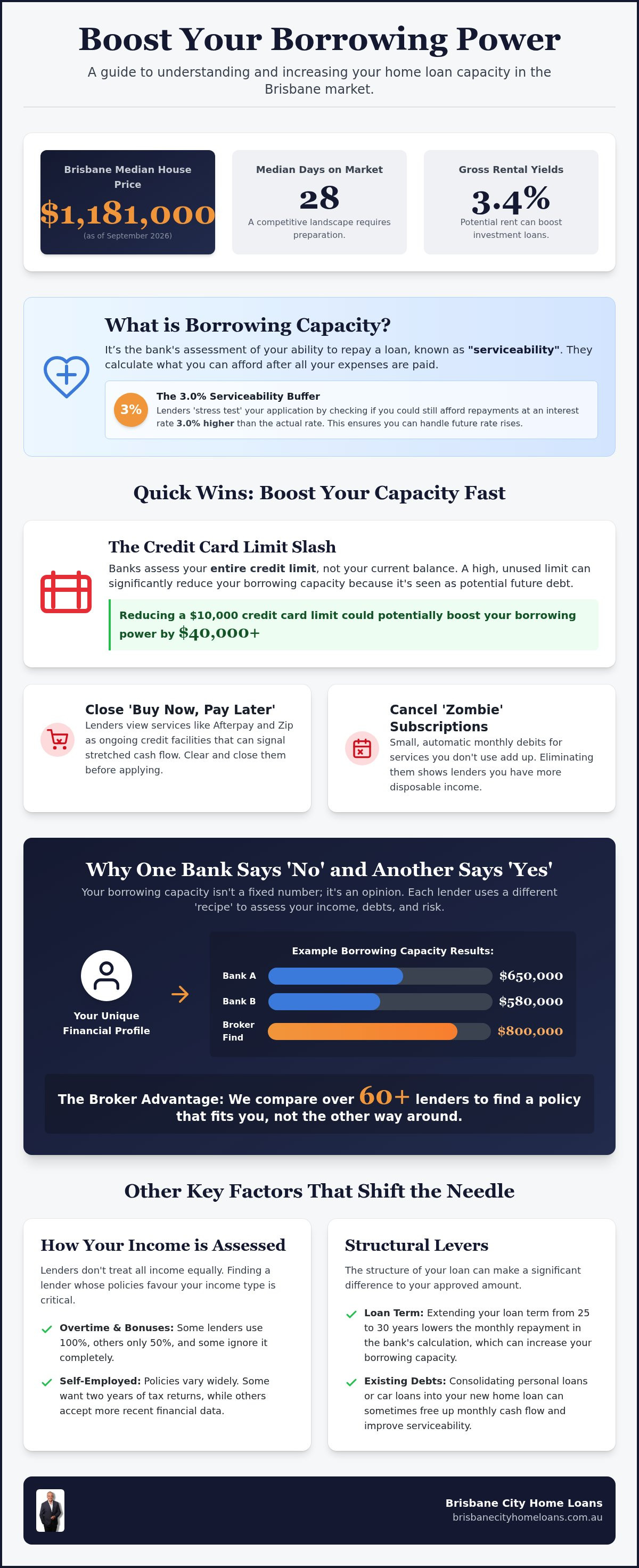
Lenders don't just look at today's interest rates when they do these sums. They apply what's called a serviceability buffer. Currently, they test your ability to pay back the loan at a rate that is 3.0% higher than the actual rate you'll be paying. This is a financial stress test. They want to be certain you'll stay afloat even if the market shifts. Because of this, your borrowing limit might feel lower than you expected, but it's often a starting point rather than a final answer.
The Brisbane Context: Buying in 2026
The Brisbane market has moved quickly over the last few years. With the median house value now sitting at approximately $1,181,000, your borrowing capacity has become the "key to the city." Whether you're eyeing a family home in Chermside or a character cottage in Paddington, you need to know your exact limit before you hit the weekend open homes. The market is competitive, and properties are currently spending a median of 28 days on the market. Having your finances tidied up means you can act with confidence when you find the right place.
For those looking at investment loans, there's a bit of a silver lining. Brisbane's gross rental yields are around 3.4%. Many lenders will factor a portion of that potential rent into your income. This can provide a helpful lift to your numbers, making it easier to secure a property in a high-demand area.
Why One Bank Says No and Another Says Yes
Here is the secret most big banks won't tell you. Your borrowing capacity isn't a fixed, universal number. It is an opinion. Every lender has its own "recipe" for how they calculate risk. One bank might be very strict about your Debt-to-Income (DTI) Ratio, while another might be more flexible if you're a first home buyer with a solid career path.
This is why talking to just one bank is a gamble. They can only offer you their specific view. When I work with clients, I look at 60+ different lenders. Some are generous with overtime and bonuses. Others are great for self-employed locals. If you've been frustrated by a low estimate from your current bank, don't lose heart. Learning how to increase borrowing capacity Brisbane often starts with simply finding the lender that views your specific financial "shop window" in the best possible light.
Quick Wins: How to Increase Borrowing Capacity Fast
Most people think the only way to borrow more is to get a massive pay rise. While a bigger salary certainly helps, there are several "low-hanging fruit" fixes you can tackle in just a few weeks. If you are looking at how to increase borrowing capacity Brisbane, the first step is often tidying up your financial shop window before a lender takes a peek. Banks aren't just looking at what you earn; they are looking at what you are committed to spending elsewhere.
One of the biggest hurdles today is the "Buy Now, Pay Later" (BNPL) trap. Services like Afterpay or Zip might feel like small, harmless conveniences, but lenders often view these as ongoing credit facilities. Even a few active "pay later" plans can signal to a bank that your monthly cash flow is stretched. Before you apply, it's a smart move to clear those balances and close the accounts. You can use Moneysmart's Borrowing Power Calculator to see how even small monthly commitments can eat into your potential loan amount.
Before Andrew starts your application, consider this quick financial grooming checklist:
- Close any credit cards you don't actually use.
- Reduce the limits on the cards you decide to keep.
- Cancel "zombie" subscriptions that auto-bill you every month.
- Ensure your bank statements don't show excessive gambling or unmanaged debt.
The Credit Card Limit Slash
This is where many borrowers get caught out. Banks don't care if your credit card balance is zero. They only care about the limit. If you have a card with a $10,000 limit, the lender assumes you could go out and spend that entire $10,000 tomorrow. To protect themselves, they factor in a monthly repayment for that full amount, which directly reduces what you can put toward a mortgage.
The impact is often much larger than you'd expect. In some cases, closing a $10,000 credit card could potentially add $40,000 or more to your maximum loan limit. It's a massive multiplier effect. If you don't need the high limit, dropping it down or getting rid of the card entirely is one of the fastest ways to move the needle. Just make sure you do this a few weeks before applying so the change shows up on your credit report.
Tidying Up Living Expenses (The HEM Factor)
Lenders use a benchmark called the Household Expenditure Method (HEM) to estimate what it costs you to live. However, they still look closely at your actual bank statements from the last three months. If your statements are full of daily takeout, expensive luxury shopping, or high-end gym memberships you never use, the bank might decide your "real" living costs are much higher than the HEM average.
A few months of "clean" living can make a world of difference. This doesn't mean you have to stop buying coffee, but it does mean showing the bank that you are in control of your money. If you'd like a non-judgmental look at your spending habits, Andrew can help you review your statements to see how a lender might interpret them. Sometimes, a few small tweaks to your weekly habits are all it takes to get that "yes" from the right bank.
Income Strategies: Making Every Dollar Count
When you're trying to figure out how to increase borrowing capacity Brisbane, looking at your base salary is only half the story. Most lenders don't just see a dollar and count a dollar. They apply what's called "shading" to certain types of income. This is a safety margin where a bank might only recognise 80% of your rental income, bonuses, or commissions. They do this to protect themselves against fluctuations, but every bank has a different rulebook for how they apply these cuts.
Your employment history also carries a lot of weight. Banks love stability. If you've just started a new job and you're still on probation, some lenders will flat out say no. Others are perfectly happy to lend if you've stayed in the same industry for a few years. It's all about how you present your story. Showing a consistent track record can often be the difference between a "maybe" and a "yes" when you're pushing for a higher loan amount.
Bonuses, Overtime, and Commissions
Do you work a lot of extra shifts as a nurse or a tradie? Or perhaps you rely on a healthy annual bonus? This is where the choice of lender becomes critical. Some banks might only take 50% of your overtime into account, while others will take the full 100%. Andrew knows which lenders are "friendly" to healthcare workers and emergency services staff who rely on those extra hours.
Sometimes, your latest payslips don't tell the whole story. If your income varies throughout the year, providing two years of tax returns can often unlock more capacity. This gives the bank a broader view of your earning power, rather than just a snapshot of the last fortnight. By comparing 60+ lenders, Andrew can find the one that treats your hard-earned overtime most favourably.
Self-Employed and "Gig Economy" Workers
Running your own business in Brisbane is rewarding, but it can make the banks a bit nervous. They tend to look at your "bottom line" profit, which might be lower than your actual cash flow due to tax-deductible expenses. A broker helps by identifying "add-backs." These are things like depreciation or one-off equipment purchases that shouldn't count against your ability to pay back a loan. We basically translate your tax returns into "bank-speak" so the credit team understands your true financial strength.
If you're an AFL player, a consultant, or a freelancer, your income might look "lumpy" to a computer system. It's important to remember that self-employed home loans require a more nuanced approach. We don't just tick boxes; we build a case for why you're a great borrower. Finding a lender that understands the gig economy can significantly boost your results when looking at how to increase borrowing capacity Brisbane.
Structural Levers: Terms, Deposits, and Splitting
Did you know that how you set up your loan is just as important as how much you earn? It's true. Banks use different calculators for different loan structures. If you're hitting a wall with your current lender, changing the "levers" of your mortgage might be the answer. This is a core part of learning how to increase borrowing capacity Brisbane. It isn't just about finding more money; it's about making the money you have work harder in the eyes of a bank's credit team.
When you have a larger deposit, you reduce the bank's risk. This is measured by your Loan-to-Value Ratio (LVR). If your LVR is lower, some lenders become more flexible with their internal rules. They might be willing to overlook a slightly higher debt level if they know there's plenty of equity in the property. It's all about making the bank feel safe and secure in the deal.
Extending the Loan Term
Most people aim for a 30-year loan term when they want to maximise their capacity. Why? Because it spreads the repayments over a longer period. This makes your monthly commitment look smaller on paper, which allows the bank to lend you more. You don't have to take 30 years to pay it off, though. You can still make extra repayments or use an offset account to smash that debt down faster once you're in the home.
If you're over 50, the bank might ask for an "exit strategy." They want to know how you'll manage the loan when you retire. This could involve downsizing later or using superannuation. For most buyers, however, the 30-year term remains the gold standard for getting that initial "yes" on a higher loan amount.
The Power of a Guarantor
Sometimes the income is there, but the deposit is the bottleneck. This is where a family guarantee can be a game changer. By using a small portion of a parent's home equity as extra security, you can often bypass the need for a massive cash deposit. This improves your buying position and can help you avoid Lenders Mortgage Insurance (LMI).
A guarantor arrangement directly improves your LVR. As we mentioned earlier, a better LVR can sometimes lead to more favourable lending policies. If you're curious about how this works for local buyers, check out our guarantor home loan brisbane guide. It's a popular way for Brisbane families to help the next generation get into the market without waiting years to save a huge lump sum.
For investors, interest-only periods can help with cash flow, but they can be a double-edged sword for capacity. Banks often stress test your ability to pay back the loan based on the remaining "principal and interest" term. If you have a 5-year interest-only period on a 30-year loan, the bank calculates your repayments as if you have to pay the whole thing back in 25 years. This can actually lower your borrowing capacity. It's a bit of a balancing act, and it's worth chatting through the pros and cons before you decide.
If you want to see which structural levers will work best for your specific situation, book a quick chat with Andrew to run the numbers.
The Broker Advantage: Andrew’s 60+ Lender Strategy
Walking into your local bank branch might feel like the easiest path, but it's often a gamble with your future home. Every lender in Australia has its own "secret sauce" for calculating what you can afford. If one bank gives you a low estimate, it doesn't mean you're stuck. It just means your finances didn't fit their specific, narrow box. My job is to look at the bigger picture and find the lender that actually says "yes" to your goals.
My process involves stress-testing your unique scenario across a panel of 60+ different lenders. I don't just guess what your limit might be. I run your numbers through multiple bank calculators to see which ones view your situation most favourably. This is a core part of how to increase borrowing capacity Brisbane for my clients. It turns a frustrating, low estimate into a clear, actionable plan. Best of all, my service is completely free for you and entirely non-judgemental. Whether your bank statements are a bit messy or you're just starting out, I'm here to guide you, not to lecture you.
The "Lender Policy" Lottery
Banks change their appetite for new business like the Brisbane weather. Some months, a major bank might be "hungry" for first home buyers and offer more flexible terms. Other months, they might tighten their belts and focus only on low-risk refinancing. I have access to "behind the scenes" software that tracks these shifts in real-time. I can see which banks are currently looking for customers just like you.
If your situation is a bit "outside the box," a broker is your best advocate. Perhaps you're a contractor, or maybe you have a unique income structure that a computer algorithm doesn't quite understand. I can talk directly to the credit teams to explain your story and push for a better outcome. Choosing Brisbane City Home Loans means you get local, personalised service from a real person who knows the Brisbane market inside out.
Your Next Steps to a Higher Limit
Getting your finances ready doesn't have to be a high-stress event. The process is simple. We start with a quick, relaxed chat to understand what you're trying to achieve. Then, we do a document review to see exactly what the lenders will see. Finally, we build a strategy to help you reach that target loan amount. It's about taking the guesswork out of the application process.
It's never too early to start planning. Even if you aren't planning to buy for another six months, a "financial health check" now gives you plenty of time to tidy up your spending habits or close those unnecessary credit cards we discussed earlier. Being proactive is the best way to ensure you're ready to pounce when you find that perfect home in Paddington or Chermside. Ready to see what's possible? Book a free consultation with Andrew today and let's get your Brisbane property journey moving in the right direction.
Ready to Secure Your Dream Brisbane Home?
You now have a clear roadmap for your financial journey. Remember, that first number a bank gives you is just one opinion. By tidying up your credit card limits, understanding how different lenders view your overtime, and choosing the right loan structure, you can change the outcome. Learning how to increase borrowing capacity Brisbane isn't about magic tricks; it's about making smart, practical choices before you head to your next open home.
You don't have to navigate these complex rules alone. As a local Brisbane expert, I've helped many people just like you find a way forward without any judgement. My service is completely free for you, and I have access to 60+ lenders to find the one that fits your life perfectly. Why settle for one bank's answer when you can compare sixty? Ask Andrew to check your borrowing capacity for free today. Let's find out what's really possible for your future and get you one step closer to that front door.
Frequently Asked Questions
How much does a credit card limit reduce my borrowing capacity?
Your credit card limit has a much bigger impact than your actual balance. Lenders assume you might max out the card at any time, so they factor in a monthly repayment for the full limit. Even if you pay it off every month, a $10,000 limit can slash your borrowing capacity by roughly $40,000. Reducing your limits or closing unused cards is a quick win for your application.
Can I increase my borrowing capacity if I am self-employed in Brisbane?
You can definitely boost your capacity if you're self-employed. Most banks look at your taxable income, which is often lower due to expenses. I help by identifying "add-backs," like depreciation or one-off equipment costs, that the bank should ignore. By comparing 60+ lenders, I find those that understand business cash flow better than a standard computer algorithm, helping you get a fairer result for your hard work.
Does HECS/HELP debt affect how much I can borrow for a home loan?
Yes, your HECS or HELP debt does affect your home loan. Lenders look at your net take-home pay, and because HECS repayments are deducted from your salary, it reduces the amount you have available to service a mortgage. In some cases, paying off a small remaining HECS balance before you apply can significantly increase your borrowing power, as it clears up that monthly cash flow immediately.
Will a pay rise immediately increase my borrowing power?
A pay rise can help, but it isn't always an instant fix. Most lenders want to see at least one or two payslips at the new rate. If the pay rise comes with a new job and a probation period, some banks might want you to wait until that's finished. However, if you've stayed in the same industry, I can often find lenders who will accept the higher income straight away.
How do lenders view "Buy Now, Pay Later" (BNPL) accounts?
Lenders view BNPL accounts like Afterpay or Zip as ongoing credit commitments. Even if you don't owe much, the presence of these accounts can signal a reliance on credit for living expenses. Many banks will include a "buffer" repayment in their calculations for every active account you have. It's usually best to clear your balances and close these accounts a few months before you start your application.
Is it better to have a car loan or a higher home loan limit?
It's generally better to have a higher home loan limit than a car loan. Car loans usually have much higher monthly repayments compared to the amount borrowed. Because lenders focus on your monthly cash flow, a $400 monthly car payment can reduce your borrowing capacity by a lot more than $40,000. If you can avoid car finance while you're house hunting, you'll likely secure a much larger mortgage.
How many months of bank statements do Brisbane lenders usually look at?
Most Brisbane lenders will ask to see your last three months of bank statements. They use these to check your living expenses and ensure you're managing your money well. If you're wondering how to increase borrowing capacity Brisbane, spending a few months "grooming" your statements by reducing takeout and subscriptions can help. It shows the bank that you're in control and ready for the responsibility of a home loan.
Can I use a second job to boost my borrowing capacity?
You can use a second job to boost your capacity, but banks have specific rules about it. Most will want to see that you've held the second job for at least six to twelve months to prove it's stable. Some lenders might only count 80% of that extra income, while others are more generous. I'll help you find a lender that treats your extra hustle with the respect it deserves.


